Social-care planning and prediction for local authorities using AI analytics
Using data to manage and predict social-care pressures.
The Challenge
Local authorities must plan social-care provision for growing, ageing populations within hard capacity and budget constraints. Their data is fragmented across many source systems, wellbeing outcomes are rarely analysed at scale, and both over- and under-provisioning of services carry heavy cost and human consequences — yet most councils lack tools to see demand coming or to test the impact of adverse events before they happen.
The Solution
NquiringMinds’ Care Analytics applies AI to the strategic management and planning of social-care provision. Robust, easy-to-use tools import, clean and merge data from many sources into a standardised open format; AI then provides strategic and operational insight: dynamic cohort filtering and flow analysis through the care system (contact, referral, assessment, commissioning), individual service-user views with care-need and hospitalisation predictions, long-term wellbeing metrics across cohorts, scenario planning for adverse events such as a provider exiting the market, location/route optimisation for care delivery, and ONS-based service-demand and cost forecasting. Fine-grained, certificate-based permissions give organisations the confidence to share sensitive data.
Outcomes
Care Analytics was demonstrated (demo at ca-synth.nqm-2.com) and deployed with multiple councils — recorded internally as Sunderland, Oxfordshire, Southampton and Portsmouth, alongside a Welsh local authority engagement (consistent with Torfaen). The NQM product page additionally references Torfaen, Southampton City Council, Hampshire County Council, BCP and NHS Gloucestershire among care-analytics users. The end schemas are published as open source to prevent vendor lock-in and encourage open standards in social care.
In Detail
Using data to manage and predict social care pressures.
Care Analytics assists in the strategic management and planning of social care provision and ensures that it is optimised for service users within the constraints of local authority capacity. It provides robust and easy-to-use tools to import, clean and merge data from a variety of sources and uses Artificial Intelligence (AI) to provide strategic and operational insights, to perform impact analysis and to make recommendations in relation to service provision.
Download our white paper
Watch Care Analytics in action:

Core benefits
- Secure — state-of-the-art digital certificate-based security gives organisations the confidence and assurance they need to share data.
- Privacy — fine-grained permission levels ensure only the right people access sensitive information.
- Smarter Planning — tools to help plan capital and service investments reduce the costs and risks that are associated with both the over- and under-provisioning of services.
- Resilience — impact analysis is used to improve resilience and perform contingency planning, reducing the effects of emergency measures on cost and quality.
- Service Optimisation — optimising the configuration of care services and travel routes reduces the cost of care provision, improves operational efficiency and reduces CO2 emissions.
- Better Outcomes — optimising care package recommendations based on empirical outcome data, to improve the outcomes for service users and reduce the long-term cost of service provision.
- Increased Carer Pool — by recommending walkable routes, the pool of carers can be expanded to include non-drivers, reducing CO2 footprints and improving community cohesion.
- Intervention Impact — analysis of interventions over time to develop more effective care packages, leading to better outcomes and lower costs.
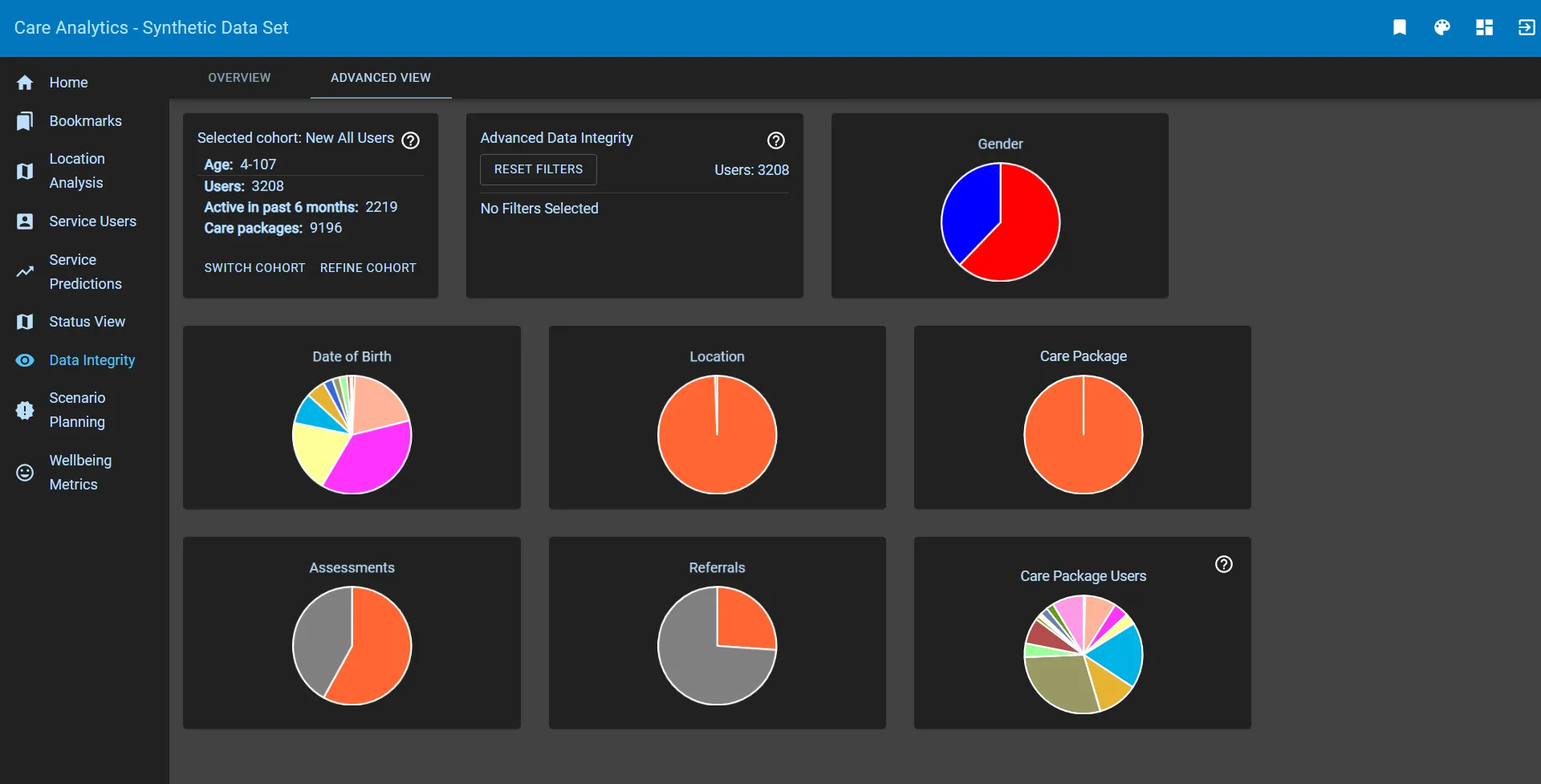
Data import & integrity. The data import module enables the import of data from diverse sources into the standardised format that powers Care Analytics. It is designed to work with new datasets with minimal configuration, and the end schemas are published as open source to prevent vendor lock-in and to encourage the adoption of open standards within social care. The Data Integrity module provides fine-grained analytics on the completeness and quality of the data that was imported, with advanced filtering options that allow administrators to analyse the quality of their data and identify areas where quality improvements would be beneficial.
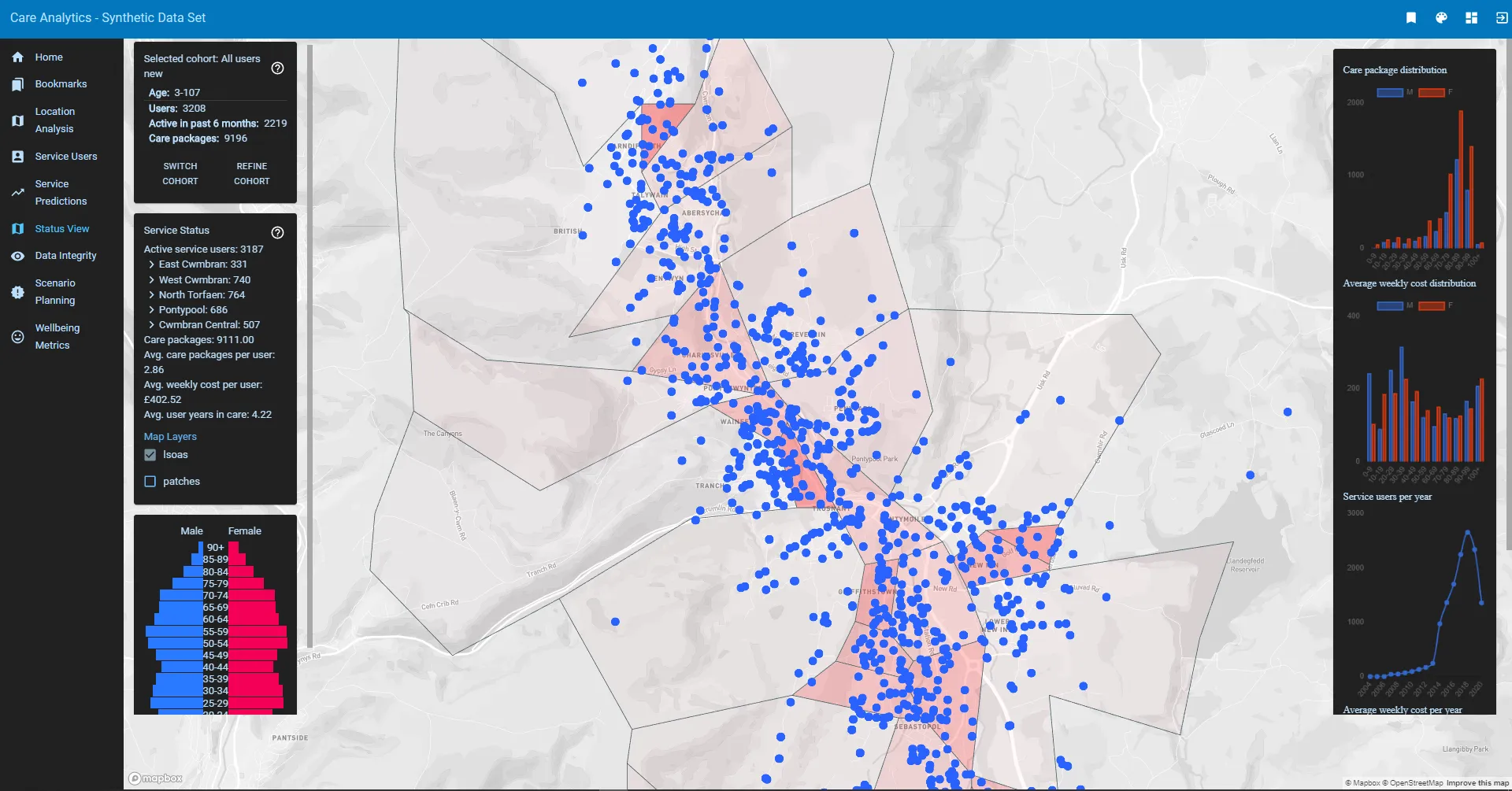
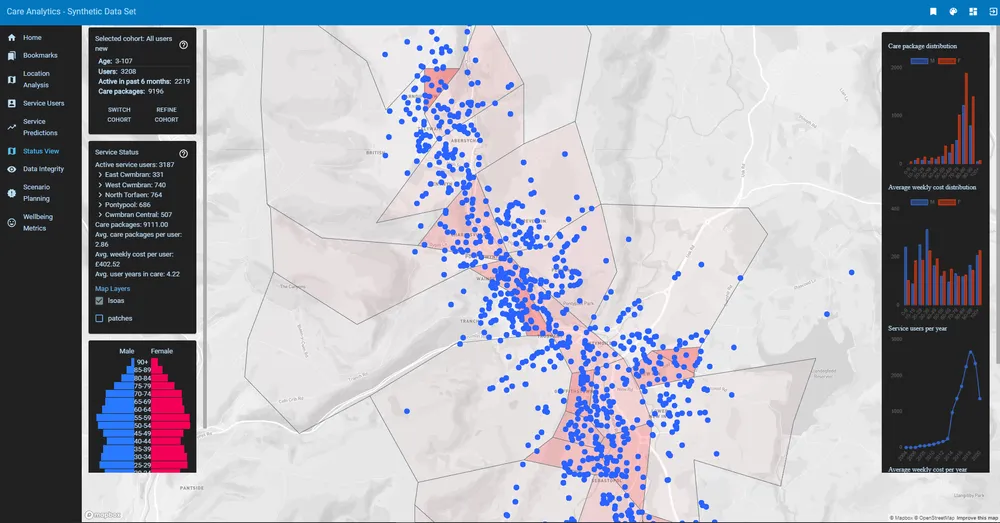
Status view. The status view provides high-level analytics based on health and social care data. Granularity: views based on how individual case histories change over time. Real-time: connected to live data sources giving a precise live view of the current situation, or updated less often if preferred. Dynamic cohorts: sub-cohorts can easily be created in any view, making it easy to drill down and perform detailed context-specific analysis. Advanced cohort definitions: cohorts can be based on advanced combinations of the attributes of individuals as well as functions of them. Integrated data: providing information from multiple data sources. Flow analysis: model flows through the social care system (e.g. contact, referral, assessment and commissioning).
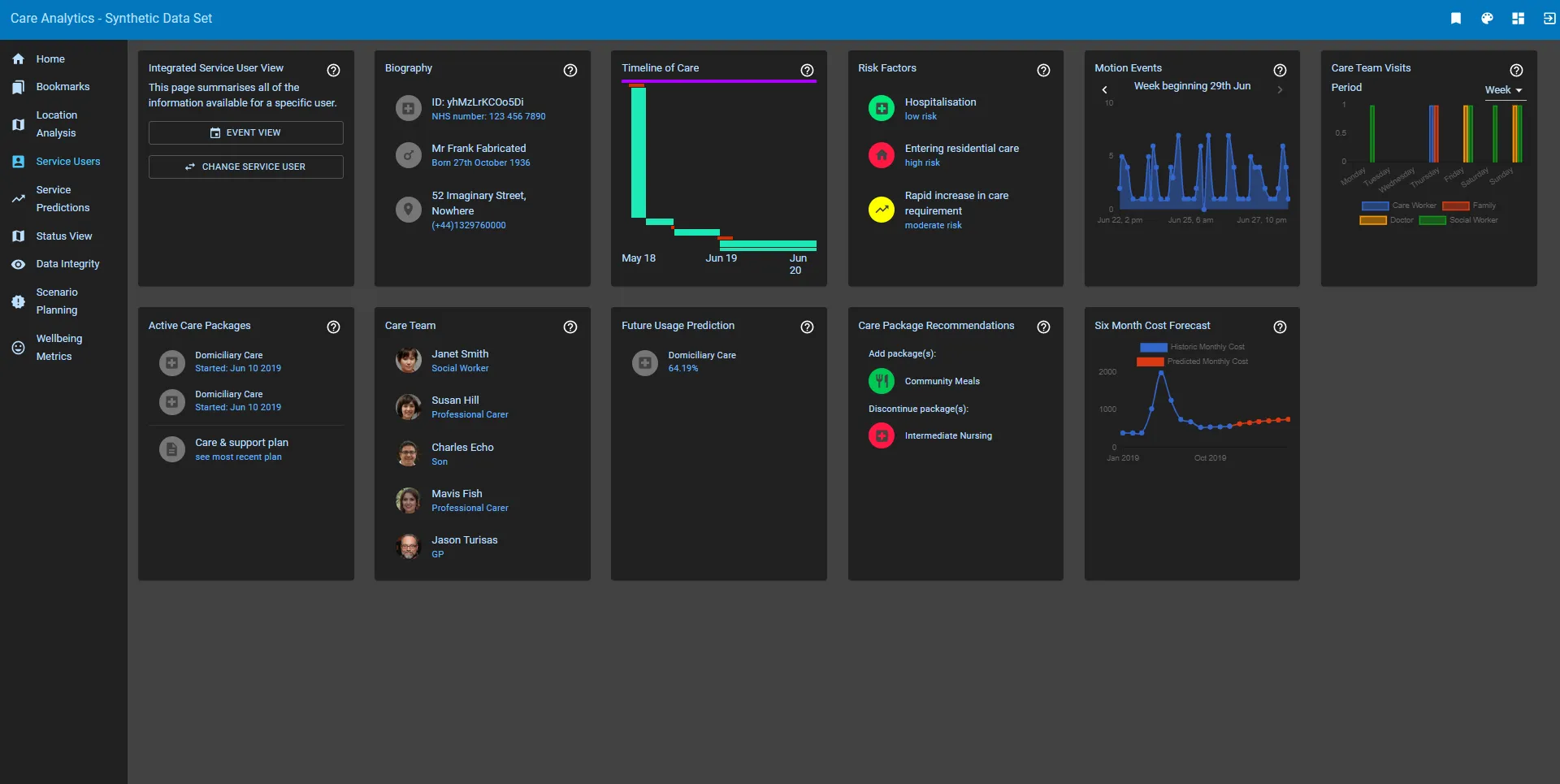
Service user view. The service user view facilitates detailed analysis of an individual service user’s care needs and provides a number of decision support tools. A complete list of service users can be refined to show only those that meet specific criteria. Selecting an individual service user provides a rich set of visualisations that combine information from multiple sources — the history and current status of the service user, recommendations for changes to their care plan, predictions relating to future care needs, and the likelihood of them requiring hospitalisation or movement to residential care.
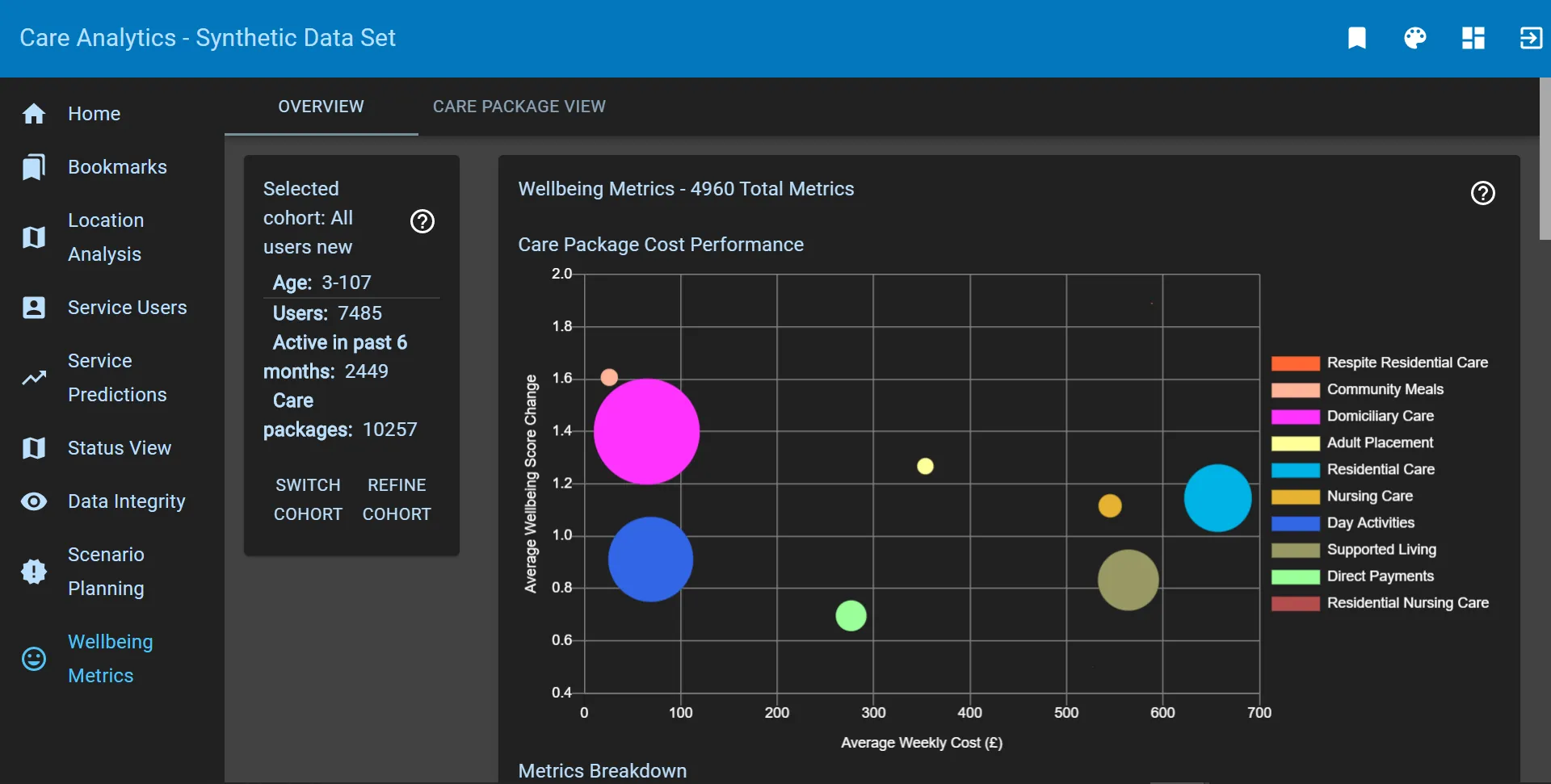
Wellbeing metrics. Many local authorities collect information on the wellbeing outcomes of their service users; however, the information is rarely analysed at scale and across multiple users. By performing long-term analysis across a cohort of users, it is possible to infer the effectiveness of a care service, not just in terms of financial cost, but also in terms of the impact on the wellbeing of a service user. This enables a much more nuanced understanding of the quality of care being delivered.
Scenario planner. The scenario planner makes it possible to investigate the impact of adverse events, such as extreme weather or a service provider exiting the market or discontinuing a specific service. It assesses the financial implications of an event, identifies the affected service users and suggests alternative providers or patch teams.
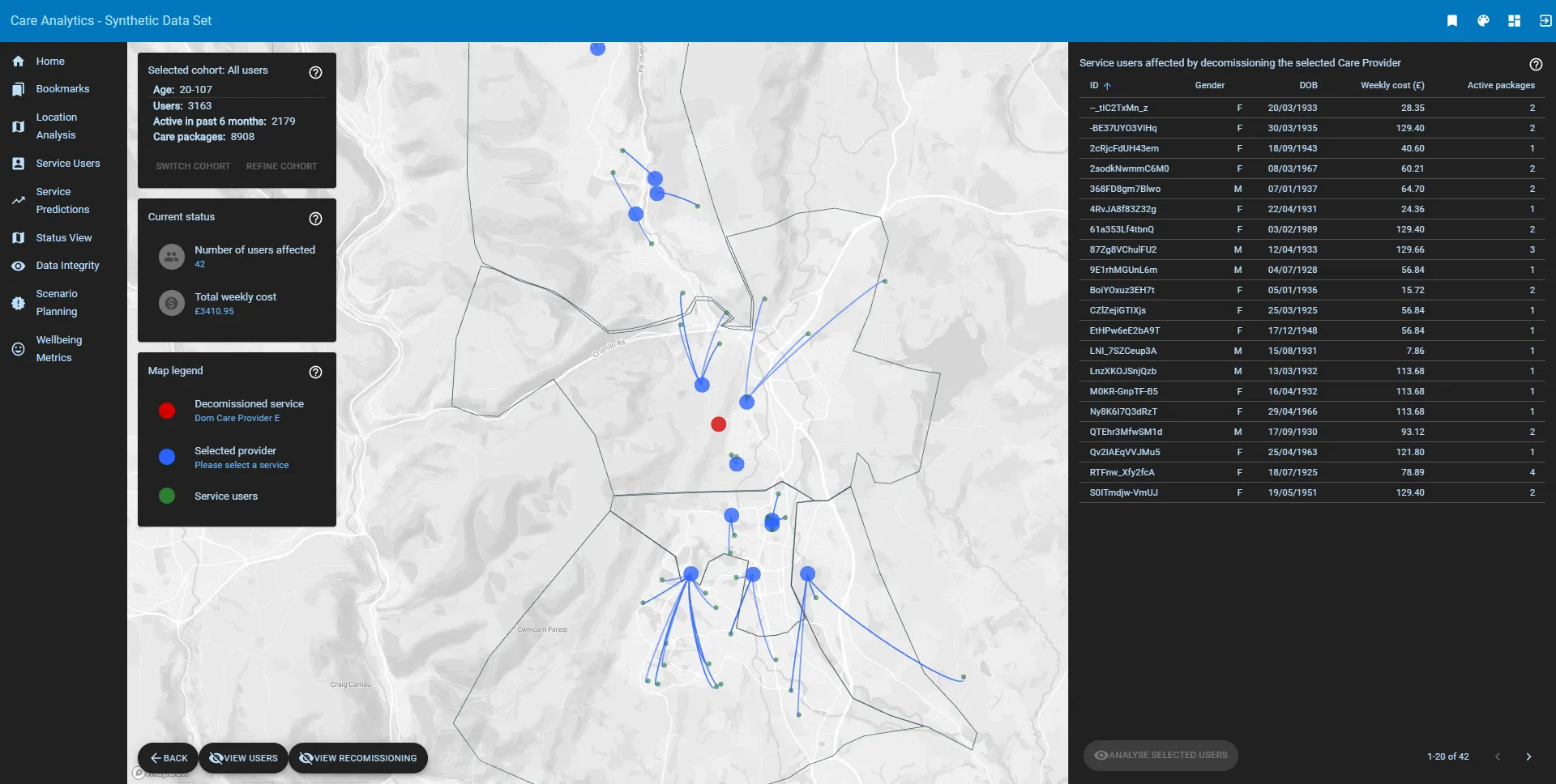
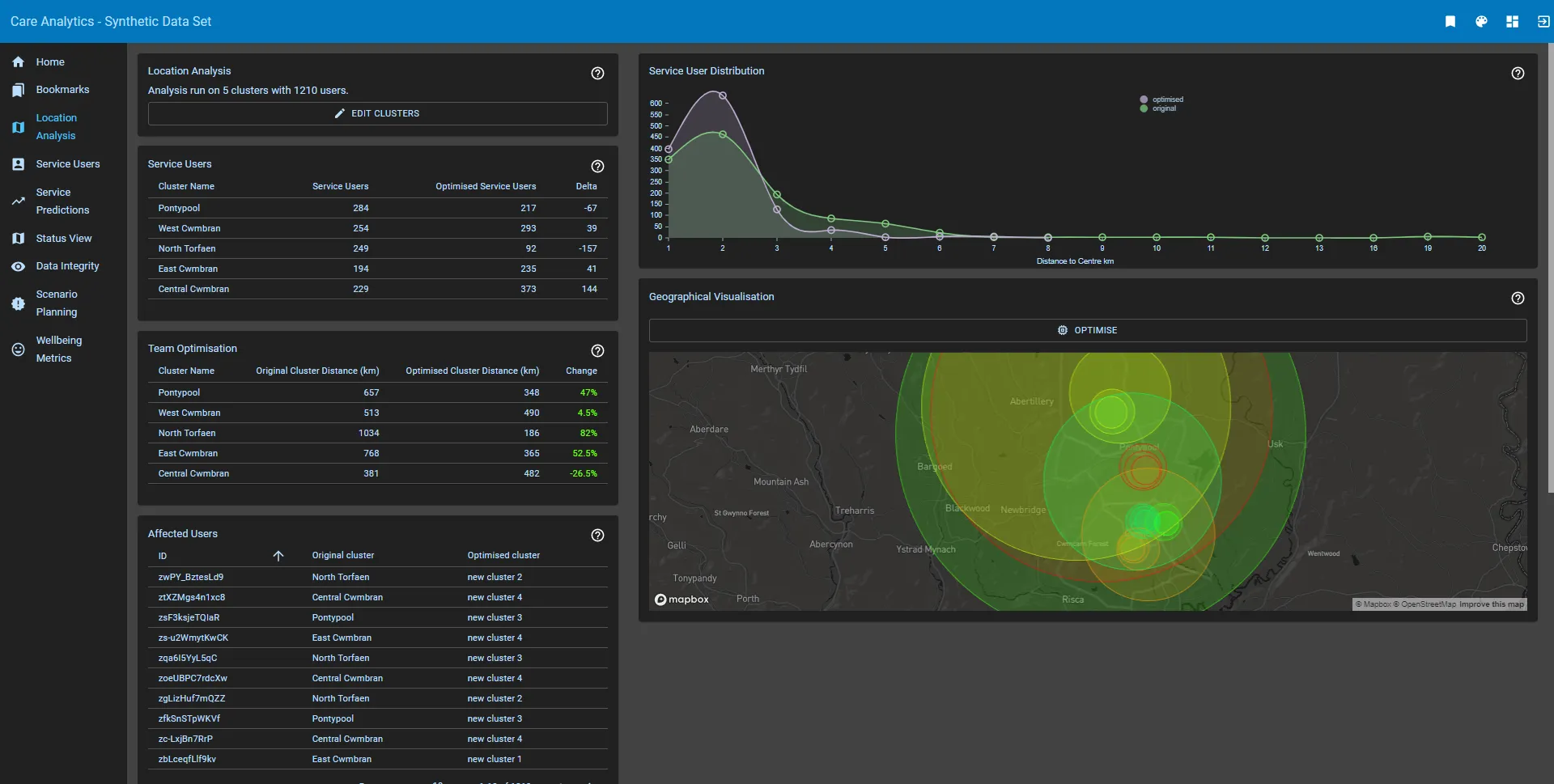
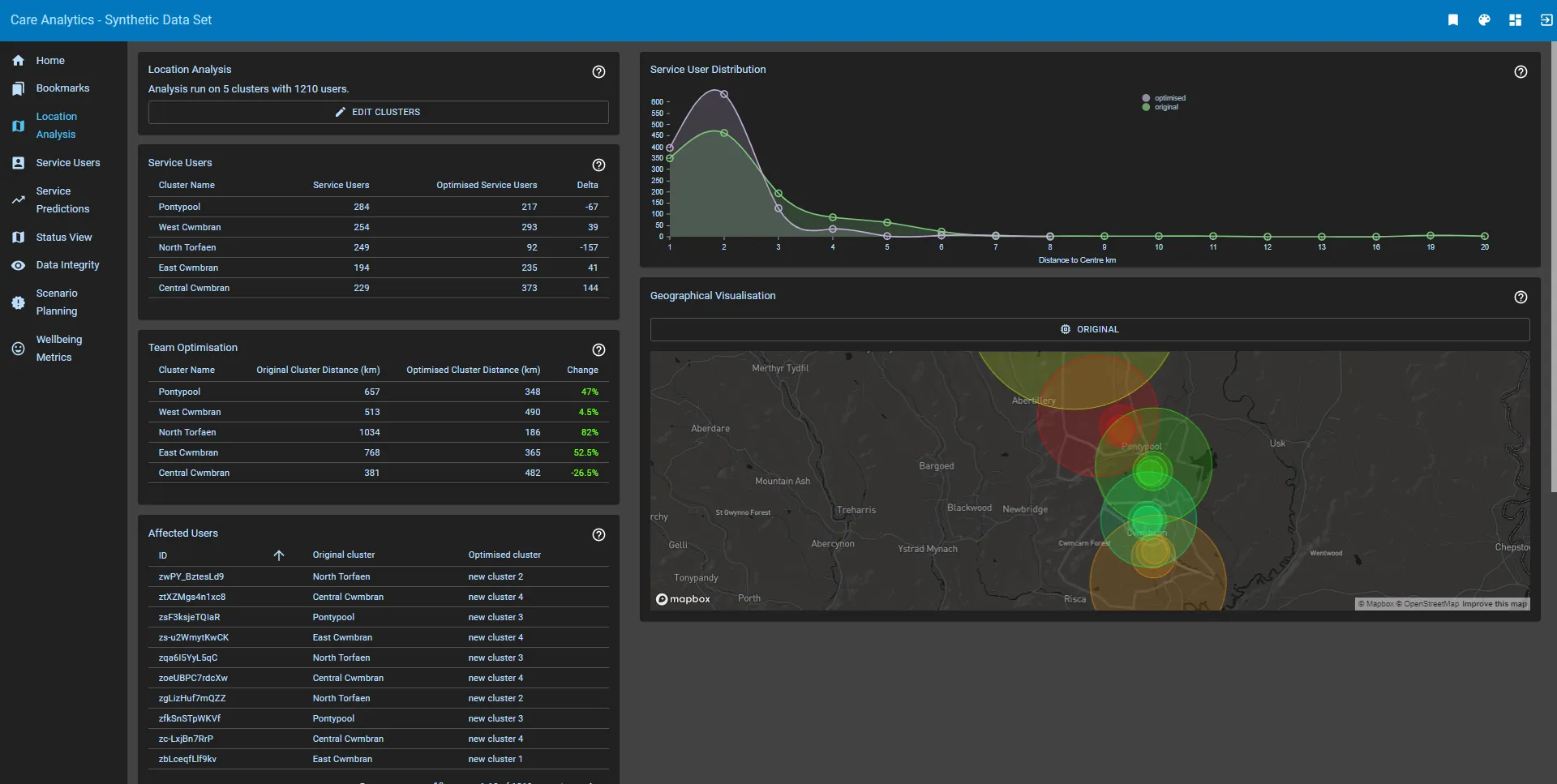
Location analysis. In the location analysis view, it is possible to see the geographical efficiency with which services are supplied to users in terms of travel time, travel cost and distance, and to use AI to optimally allocate service users to service providers and patch teams.
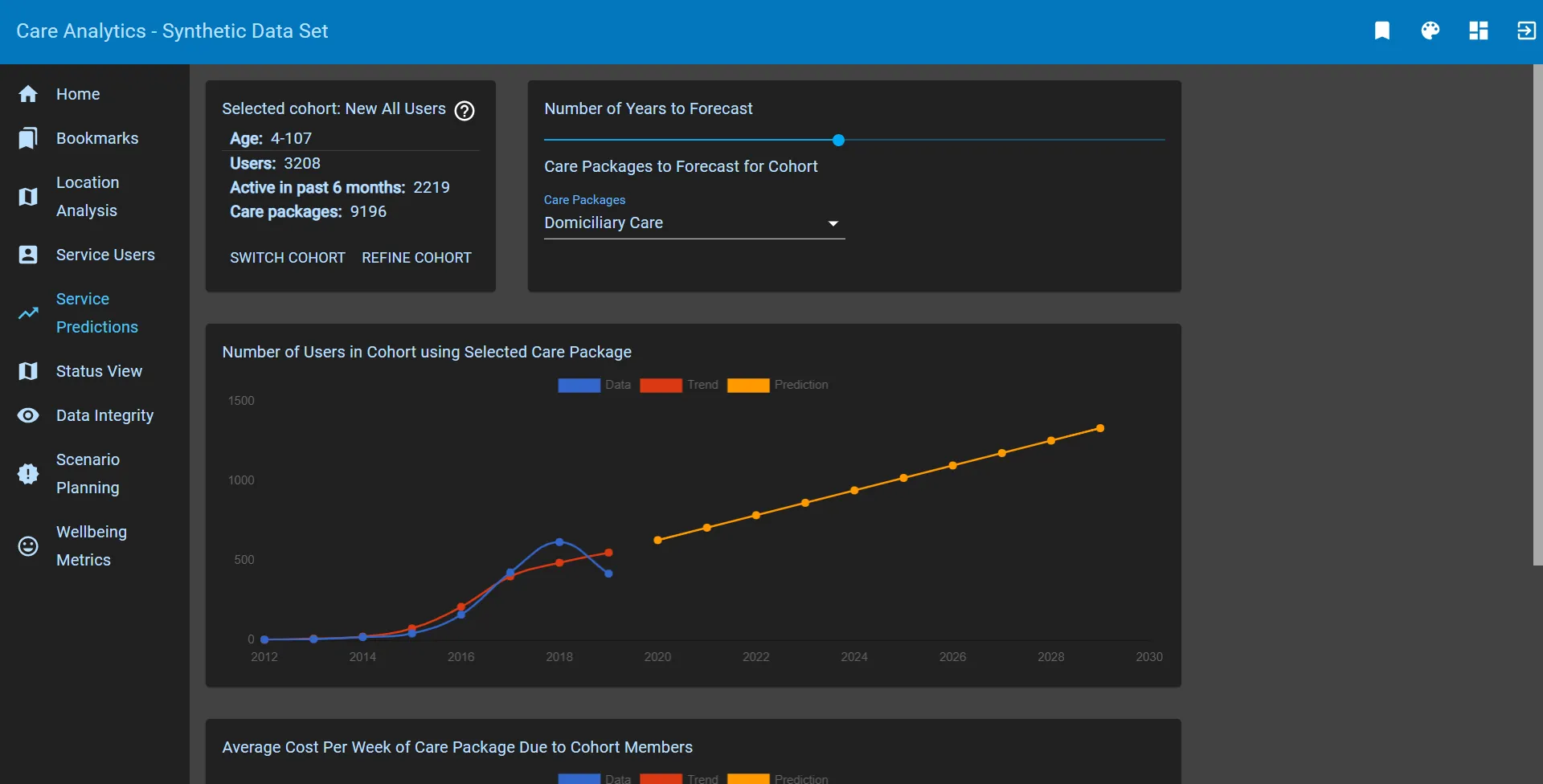
Service predictions. The service predictions module combines Office for National Statistics (ONS) population projections with local care usage data to forecast the future population in care and the cost of provisioning their care. Forecasts can be made for the entire cohort in care, or for specific subgroups defined by gender, age, type of care and community to gain deeper insights.
Features

Diverse sources into a standardised format, with fine-grained data-quality analytics.

Real-time, granular analytics with dynamic cohorts and flow analysis through the care system.

Individual histories, care-plan recommendations, predictions of future care needs, hospitalisation and residential-care risk.

Long-term outcome analysis across cohorts to infer service effectiveness beyond cost.

Impact of adverse events (extreme weather, provider market exit) with alternative-provider suggestions.

AI allocation of service users to providers and patch teams; travel time/cost/distance optimisation, including walkable routes that widen the carer pool.

ONS population projections combined with local usage data to forecast the future care population and cost.

Whole-system social-care planning on privacy-preserving trusted-data infrastructure with open published schemas.
Benefits

Reduced cost and risk from over- and under-provisioning of capital and services (documented capability).

Contingency planning and impact analysis reduce the effect of emergency measures on cost and quality.

Optimised care configuration and routes cut provision cost and CO2 emissions; walkable routing expands the carer pool to non-drivers.

Care-package recommendations based on empirical outcome data reduce long-term cost and improve service-user outcomes.

Deployed with multiple councils (Sunderland, Oxfordshire, Southampton, Portsmouth; Welsh authority under SBRI); product page also references Torfaen, Hampshire, BCP and NHS Gloucestershire as users.

Open-source end schemas published to encourage open standards in social care.
Volt features used

AI as first-order elements — fast

strong simple signed schemas

Human in and on the loop

wrap third-party / legacy systems that lack a mature API

open standards and open source, by commitment

true end-to-end encryption, peer-to-peer, no intermediate server

advanced NIST compliant security

interoperable core
Working with

Related Sectors

Healthcare
The healthcare sector comprises a wide array of services, from hospitals and clinics to medical device manufacturing and pharmaceuticals. It is a vital sector that touches everyone's lives.

Public Sector
The public sector spans central and local government, councils and public services. Data-driven decision making helps these organisations plan services, allocate resources and improve outcomes for the communities they serve.