Primary-care workforce planning for the NHS using predictive analytics
Releasing GP time with demand prediction and workforce planning for primary care.
The Challenge
General practice is an increasingly overloaded service: demand grows with an ageing population while GP recruitment stalls, and practices have few tools to predict where service stress will bite or to plan the workforce changes — pharmacists, nurse practitioners, physiotherapists — that could safely absorb demand. CCGs and practices needed practical ways to release GP time rather than simply asking for more GPs.
The Solution
CareFlow pioneered new models for planning and managing the primary-care workforce, delivered as part of the General Practice of the Future programme in partnership with NHS England and the Academic Health Science Networks. It comprised three complementary modules: GP Demand Prediction — a national population and primary-care workforce model predicting service stress points up to 15 years ahead at GP and CCG level, tunable with local development plans and deprivation/health indices; GP Workforce Substitution — a per-practice portal where best-practice workforce models (using pharmacies, nurse practitioners and physiotherapists to best effect) can be modelled, evaluating impacts on both finances and GP contact hours, drawing on substitution models from collaborative research between Wessex AHSN and NHS bodies; and GP Workforce Management — tools to continually monitor and refine new workforce models, including a “Virtual GP” concept pooling local health resources (GPs, physiotherapists, home carers) that practices can call on dynamically and administratively efficiently.
Outcomes
The work produced a working demand-and-workforce modelling system combining national demographic models with NHS consultation statistics and practice-level workforce data, taken to Beta with GP practices and CCGs invited to trial it. NOTE: web searches surface an unrelated NHS clinical-communications product also named “CareFlow” (CareFlow Connect, part-funded by SBRI Healthcare and later acquired by System C) — this is a different company’s product and must not be conflated with the NquiringMinds CareFlow project.
In Detail
Using data to match GP practice capacity with demand.
Care Workforce Analytics has been designed to determine the number of GP consultations which might be freed up by using the wider practice staff. It calculates the workforce mix required to meet the shortfall and the potential cost savings. It is based on national data sets and research, but all elements can be refined to account for local variations. It also allows PCNs and CCGs to plan future workforce requirements by examining aggregated GP practice level information on staff numbers, vacancies, trainees and upcoming retirements.
Download our white paper
Core benefits
- Secure — our technology uses state-of-the-art digital certificate-based security.
- Privacy — fine-grained permission levels ensure only the right people access sensitive information.
- Strategic Management — strategically manage the workforce and training for resilience and to meet future demand.
- Triage Demand — tactically triage and direct incoming demand to the most appropriate workforce across primary, secondary, social and community care.
- Cost Efficient — manage resources to optimise cost efficiency.
- Collaborative Resources — enable providers to share resources.
- Risk Analysis — understand the margin of error and risks entailed.
- Real Time Response — respond to real-time demand fluctuations with optimised use of existing resources.
Data import. Based on national data for the average number of consultations for each demographic band, trends in consultation rates in General Practice 2008/2009 (updated to reflect the average 3.3% annual increase in activity since then) and the percentages of these consultations which could be provided by other healthcare professionals. This data is used to calculate the estimated number of consultations which could be undertaken by these staff. The demographics, workforce and salary data are taken directly from the NHS portal, and can be updated subsequently for each practice, CCG or PCN.
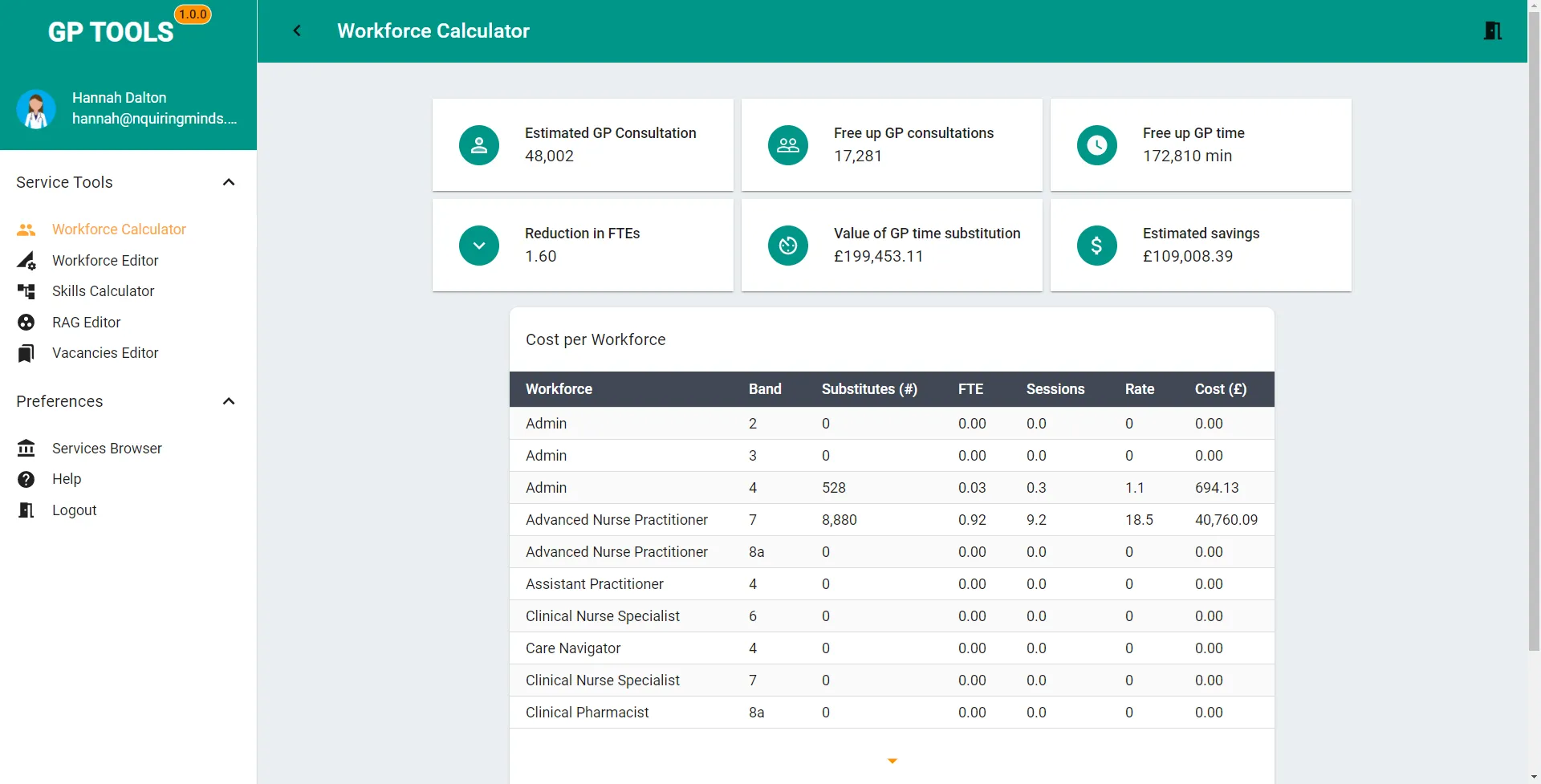
Workforce substitution calculator. Calculates the number of GP consultations which can be undertaken by non-GP staff, along with the number of GP hours that could be substituted for this, presenting the results as both sessions and Full Time Equivalent (FTE). The population demographics, utilisation rates, substitution rates, appointment durations, salaries and appointment locations (home, online, phone, surgery) can all be edited with local data where available. Average costs for employment are also provided.
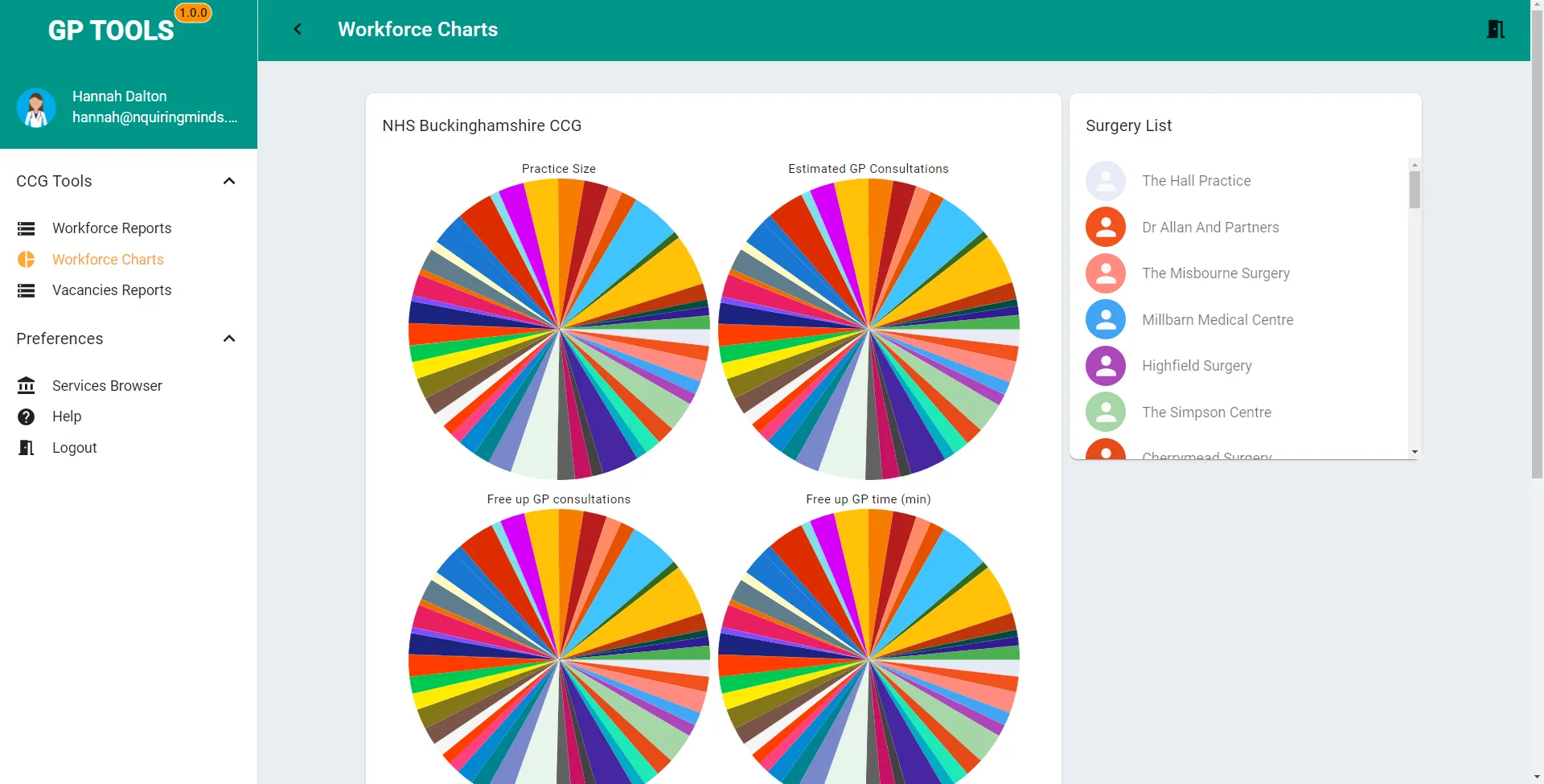
CCG & PCN views. Aggregated information about the potential for workforce substitution can be viewed at both PCN (primary care network) and CCG (clinical commissioning group) level.
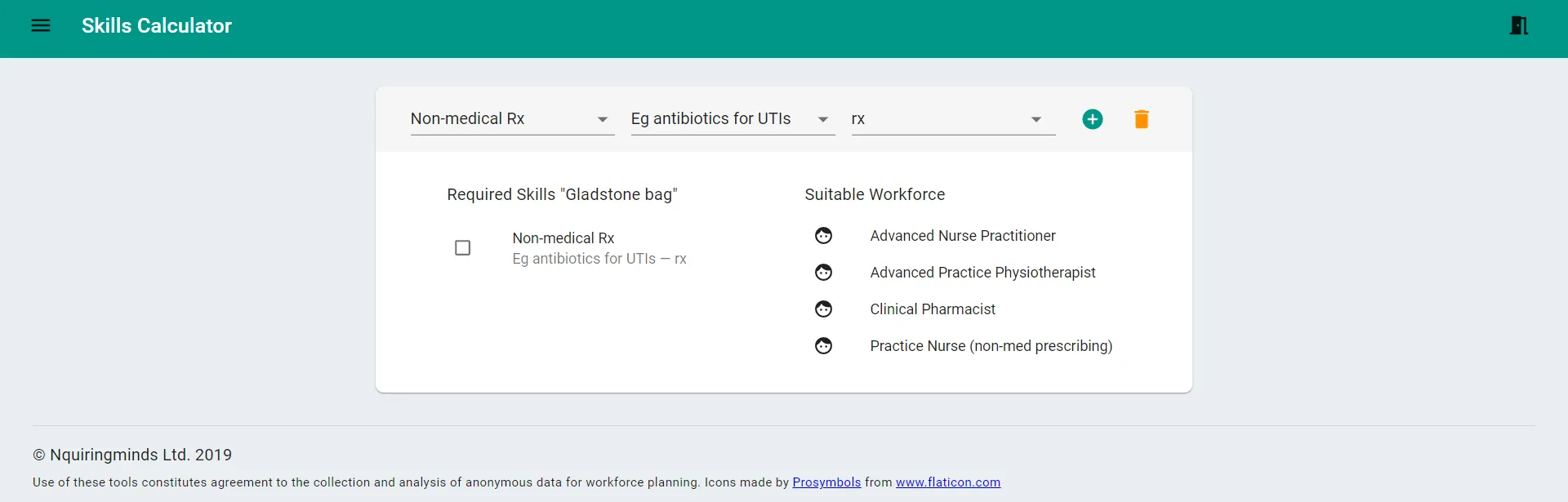
Skills calculator. GPs perform a wide range of functions, some of which have been delegated to Practice Nurses and Health Care Assistants. A number of tasks undertaken by GPs could also be managed by the wider workforce (e.g. pharmacists, physiotherapists and physician associates). The skills calculator supports the identification of staff that can undertake a set of tasks: by adding skills to the ‘Gladstone Bag’, the tool returns the list of staff who can perform all the skills selected.
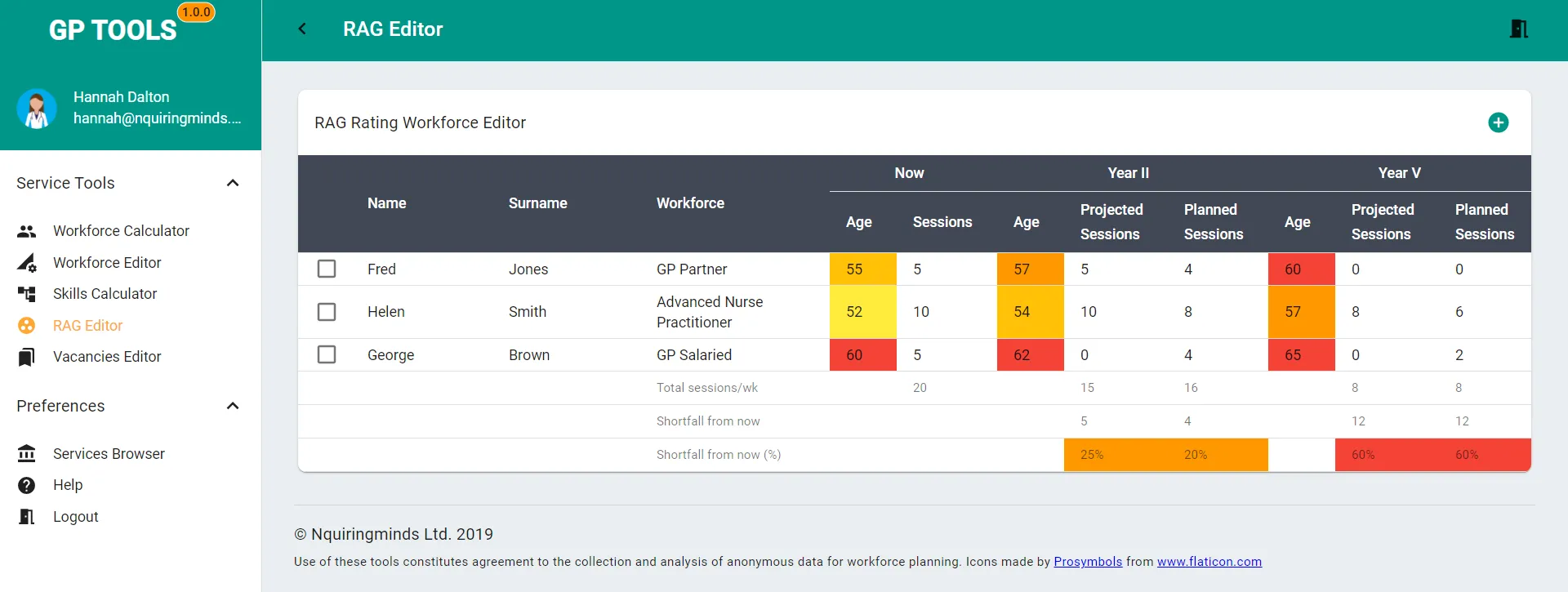
Succession planning. The Age and Sessions RAG Rating editor supports succession planning for the general practice workforce. It highlights (Red-Amber-Green) staff aged 50 to 60, assumes retirement at age 60 (based on current average retirement ages for GPs and Practice Nurses) and defaults session numbers to nil from that age. It also highlights any discrepancy — positive or negative — in session numbers in years 2 and 5, compared with now, and allows session numbers to be varied for planning purposes.
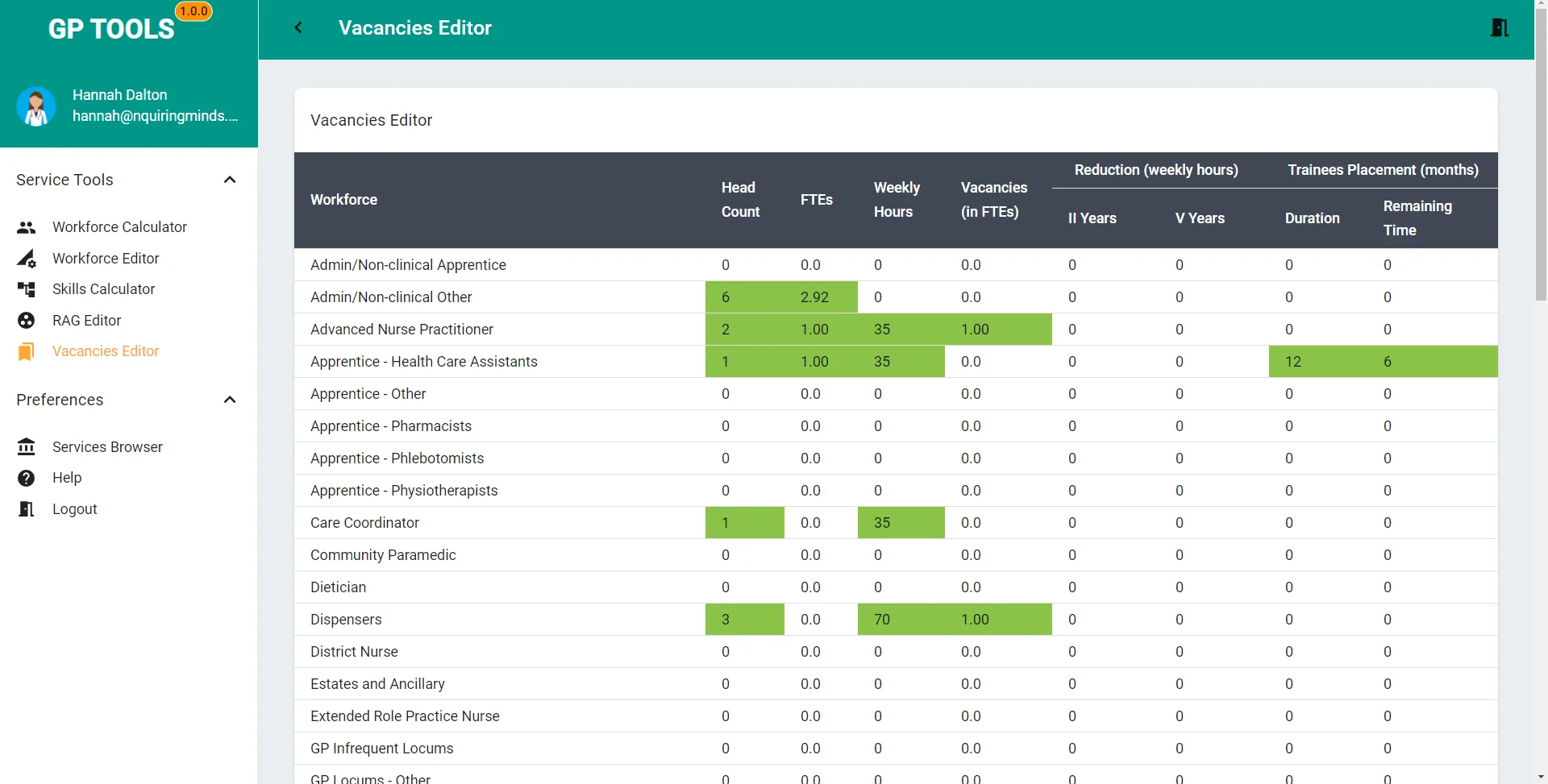
Vacancies editor. Uses national NHS data to estimate the number of FTEs for each workforce staff type in each practice. The data can be edited at practice level and allows saving the number of trainee placements and their remaining time.
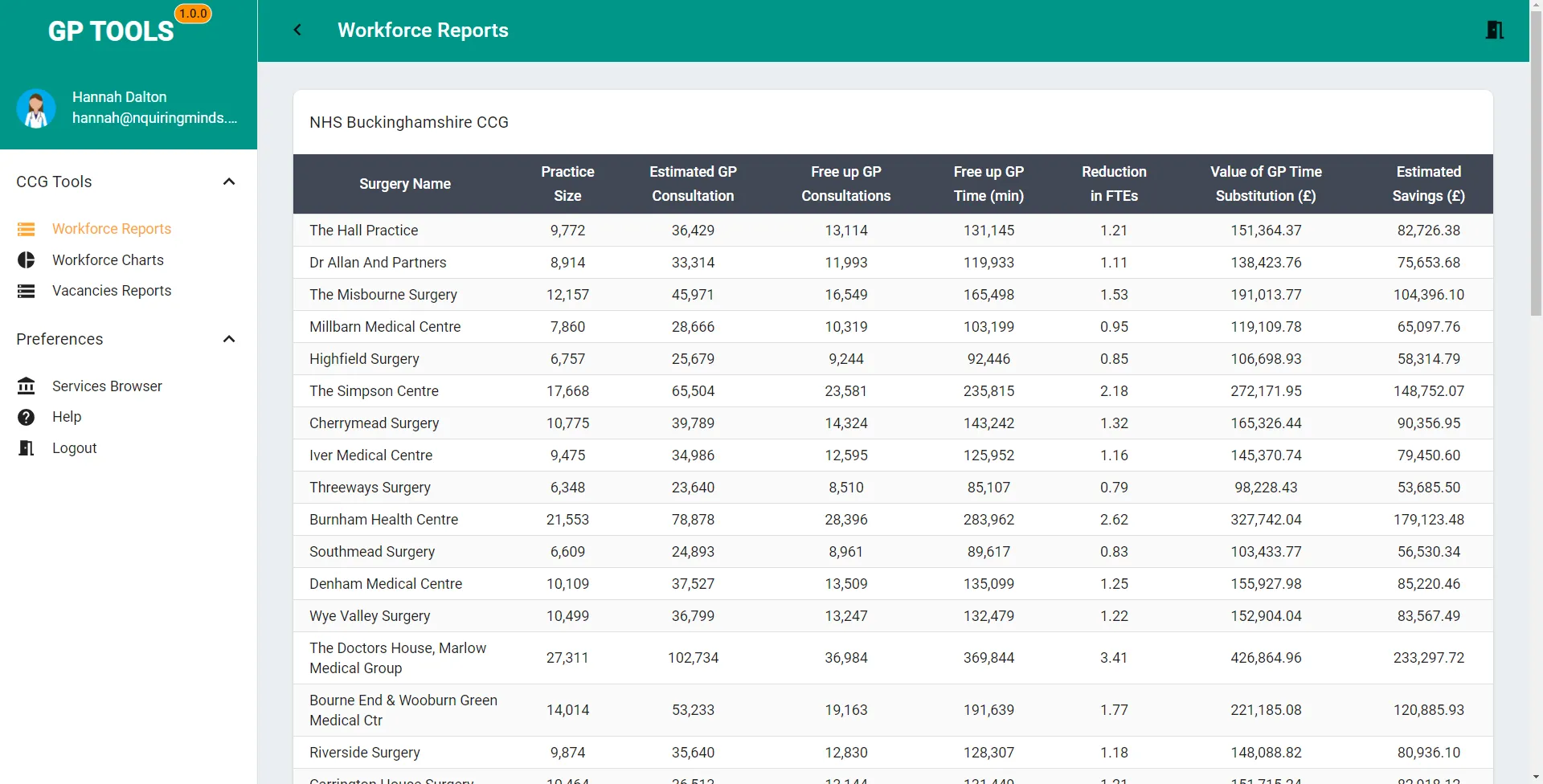
Workforce reports. Show aggregated workforce data for each practice in a CCG or PCN for both the workforce substitution calculator and general workforce planning, giving an overview of the total headcount, FTE, vacancies, trainees and retirement information for the whole CCG or PCN.

Features

National population/workforce model predicting stress points up to 15 years ahead, at GP and CCG level.

Per-practice portal modelling skill-mix scenarios and their financial and GP-contact-hour impact.

Continuous monitoring and refinement of new workforce models.

Dynamically pooled local health resources (GPs, physiotherapists, home carers) callable by local practices.

Demand model tunable by local development plans, deprivation and health indices; fine-grained workforce-churn modelling (retirement, recruits, churn).

Combined 15-year demand forecasting with evidence-based skill-mix substitution in one planning loop for primary care.
Benefits

Released GP time and reduced strain by routing suitable consultations to pharmacists, nurse practitioners and physiotherapists (documented programme aim; Beta trialled).

Financial impact of proposed workforce strategies made explicit before adoption (documented capability).

The Care Workforce Analytics tooling and the BOB GP Planner engagement.
Volt features used

AI as first-order elements — fast

strong simple signed schemas

configurable and dynamic policy

Human in and on the loop

wrap third-party / legacy systems that lack a mature API

true end-to-end encryption, peer-to-peer, no intermediate server

advanced NIST compliant security
Working with

NHS (various bodies)
Umbrella for NquiringMinds' engagements across NHS and allied health and social-care bodies, centred on secure data sharing and analytics.

Wessex AHSN
The academic health science network for Wessex (now Health Innovation Wessex), connecting NHS, academia and industry to spread health innovation.
News

CareFlow: Workflow planning and management in Primary Care
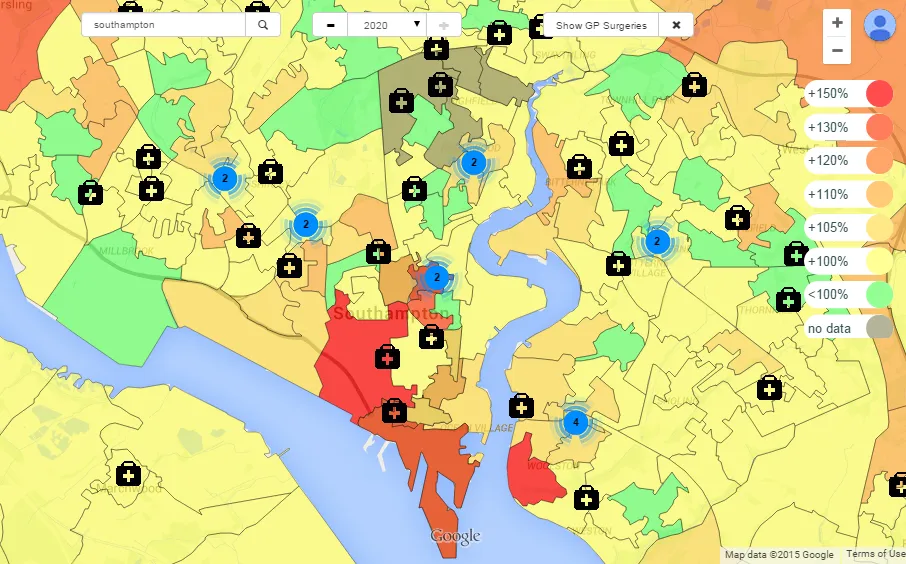
CareFlow is pioneering new models for planning and managing workforce in Primary Care. As part of the General Practice of the Future Program being delivered in partnership with NHS England and the Academic Health Science Networks, CareFlow is looking at practical ways we can innovate the way General Practice can be managed to help release.
GP Tools
nquiringminds is pleased to announce that it has won an award of £100,000 to innovate in providing solutions to pressurised GP practices in the area of workload and demand management as one of the finalist in SBRI competition. This is the first stage of an SBRI led Healthcare programme of innovations that could revolutionise GP.
Related Sectors

Healthcare
The healthcare sector comprises a wide array of services, from hospitals and clinics to medical device manufacturing and pharmaceuticals. It is a vital sector that touches everyone's lives.

Public Sector
The public sector spans central and local government, councils and public services. Data-driven decision making helps these organisations plan services, allocate resources and improve outcomes for the communities they serve.