Home-care service innovation for local authorities using a trusted digital care platform
Rethinking home care — integrating unpaid carers with professional services.
The Challenge
UK home (domiciliary) care is in crisis. The market is worth £4.62 billion a year (£3.83 billion state-funded) while unpaid carers contribute an estimated £132 billion more; demand is rising with demographic change but state provision is declining, providers are handing back unprofitable local-authority contracts, and 50% of providers have refused to tender due to financial pressures. Provision is fragmented: health, state and self-funded social care, and the huge unpaid sector barely connect, and commissioning relies on long-term, geographically ring-fenced framework contracts that fit the system, not the citizen.
The Solution
CareShare — led by NquiringMinds with the University of Southampton and Southampton City Council — developed intelligent self-care systems and a new model for home-care provision. A dynamic “find-a-carer” app and website let care be commissioned in smaller units rather than long-term contracts, and the platform fully integrates the unpaid sector (family, friends, neighbours, charities) with professional care services, approaching care from the citizen’s perspective. Data is shared between citizens and organisations in a privacy-centric way — which NQM identified as the key to fully engaging the community. Sandra Jerrim, Southampton’s Lead Commissioner for Adult Social Care, backed the project to “release capacity, create efficiency and provide individuals with greater choice”.
Outcomes
The project developed and piloted the CareShare model and “find-a-carer” platform in Southampton, cultivating closer carer–citizen relationships and more efficient commissioning. The work evolved into the CareTeam product, which continued to develop and test the platform in new settings, and NQM’s domiciliary-care innovation was showcased by the Cabinet Office (2018) for helping elderly people stay in their own homes for longer.
In Detail
Using data to manage and predict social care pressures.

CareTeam is a digital platform and mobile app designed to enable local authorities to better deliver social care. It solves the problem of care fragmentation and data privacy concerns by providing secure data sharing and messaging tools allowing collaboration between care stakeholders. It has been designed to encourage participation by informal carers, a valuable resource that is often overlooked by traditional systems. CareTeam integrates with intelligent at-home sensors to help inform and manage care provision, and allows local authorities to become more efficient and effective by using richer data and AI to provide clear, concise information to aid decision making.
CareTeam is available on Google Play and the Apple App Store.
Watch CareTeam in action:
Core benefits
- Secure — our technology uses state-of-the-art digital certificate-based security.
- Privacy — fine-grained permission levels ensure only the right people access sensitive information.
- Better Collaboration — sharing data between carers, service users and family in real time enables issues to be predicted or identified earlier.
- Integration of Unpaid Carers — incorporating day-to-day unpaid carers into care systems, insights are shared and outcomes improved.
- Defer Demand for State Support — used as an early intervention measure, CareTeam helps service users remain independent for longer.
- Access Info on the Go — carers can view service user and care visit information prior to visits so they are prepared.
- Optimise Telecare Response — sharing sensor alerts with a range of stakeholders improves response times and reduces costs.
- Integration with Sensors — avoids vendor lock-in and allows flexibility and diversity in use.
- Integrated Analytics — analytics on care provision and sensor data can spot anomalies and trends.
- Citizen Controlled Data Ownership — enables data sharing and true collaboration.
- Reduced Costs — digital recording of care visit durations enables true costs to be measured and paid for.
- Improved Outcomes — carers, social workers and families report benefits from being aware of issues earlier, to peace of mind that carers have been.
The mobile app
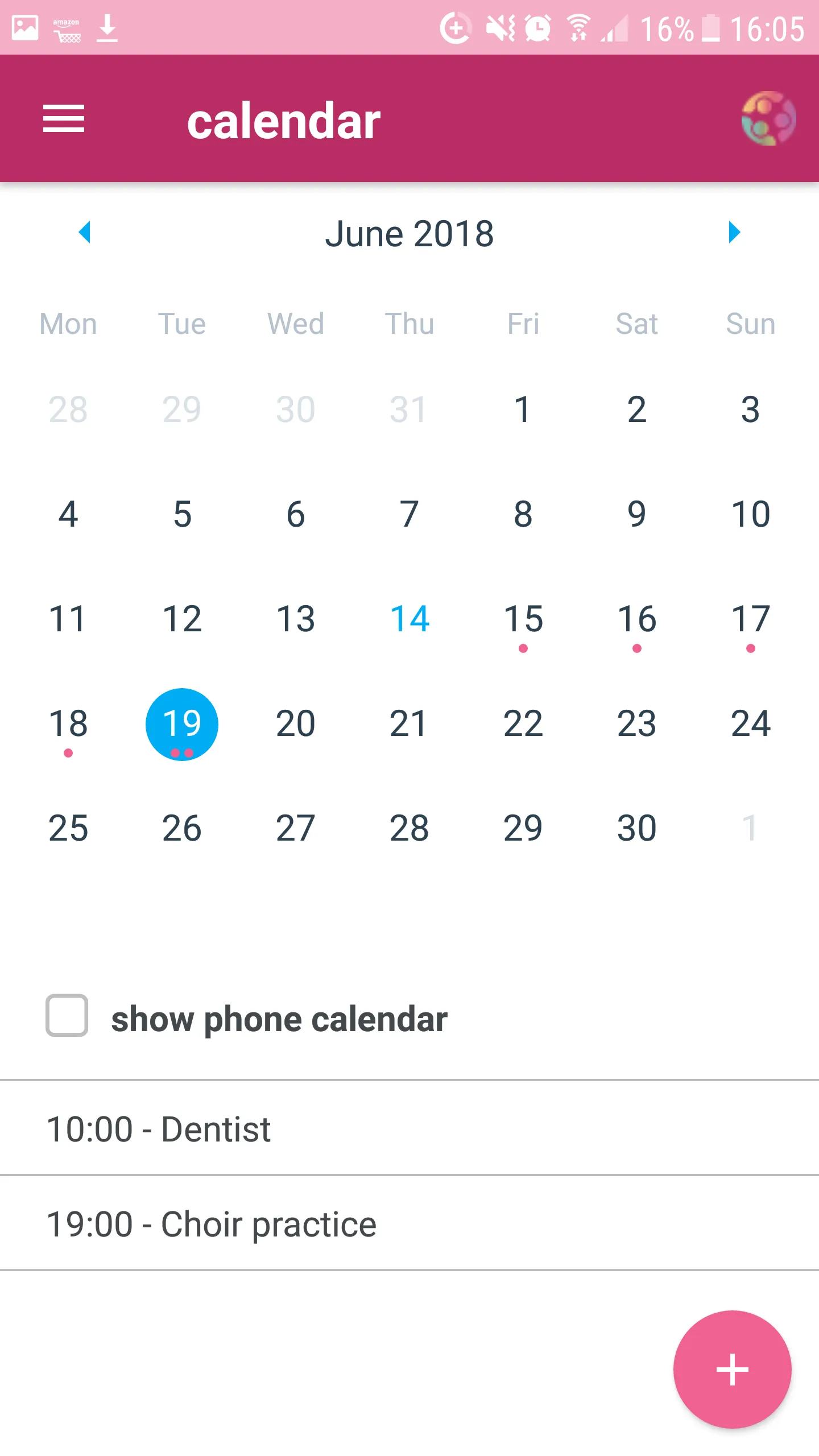
Home screen. The home page gives an overview of information and recent activity, including notifications of new messages and updates and the sensor alert status. A quick menu acts as a shortcut to add care visit information, new notes, tasks, events or messages.
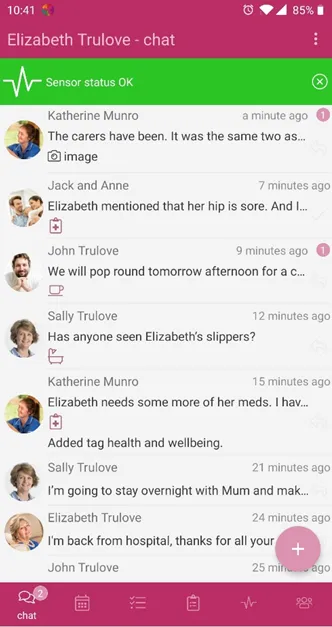
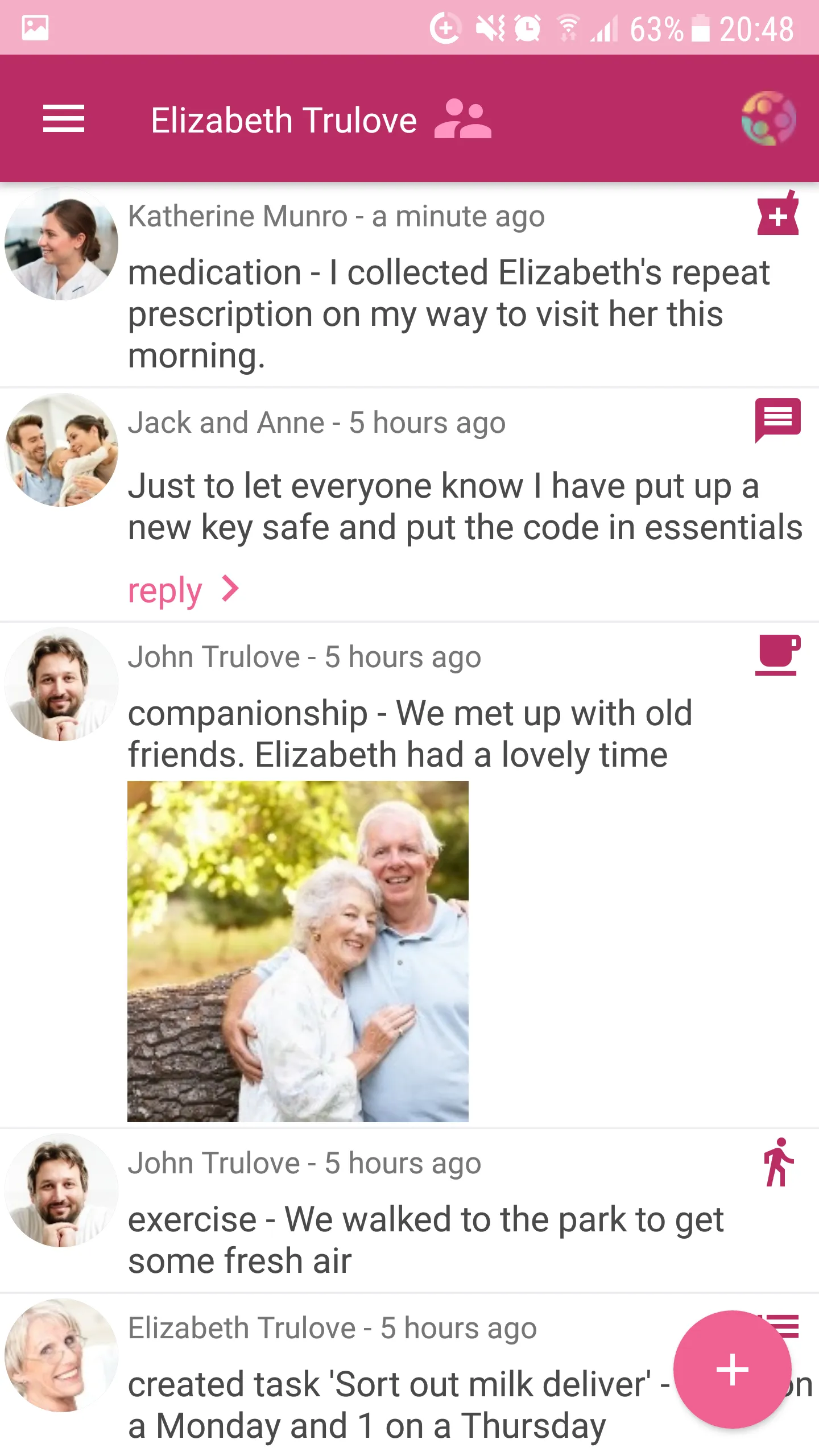
Messaging. Messages can be sent to individuals or groups. They can include pictures and can be tagged with categories such as admin and paperwork, housework, or personal care.
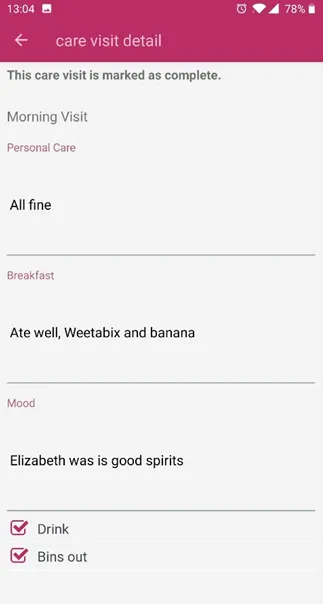
Care visit recording. Care visit recording allows tasks to be attributed to a care visit as free-field text or tick lists — free text for general wellbeing and visit notes, check boxes for food and drink requirements or specific domestic tasks. Start and end times of visits are recorded by carers, and this data and the visit notes can be shared with managers and family members in real time. Data can also be exported to other systems for timesheets and finance. Conversations can be had around visits; carers allocated to visits can accept and decline events, and all information added by carers is time- and location-stamped. Specific functionality supports employing Personal Assistants: employers and PAs can add comments regarding visits, and data is exportable to support the administrative requirements of PA employers.
Calendar. Create and selectively share events, from professional care visits to informal social events: recurring events, attendance requests, start and end times, transport requests (including pick-up and return time, number of passengers and special requirements), accept/decline invitations, event workflow status (in progress/complete), and notes and conversations about an event.
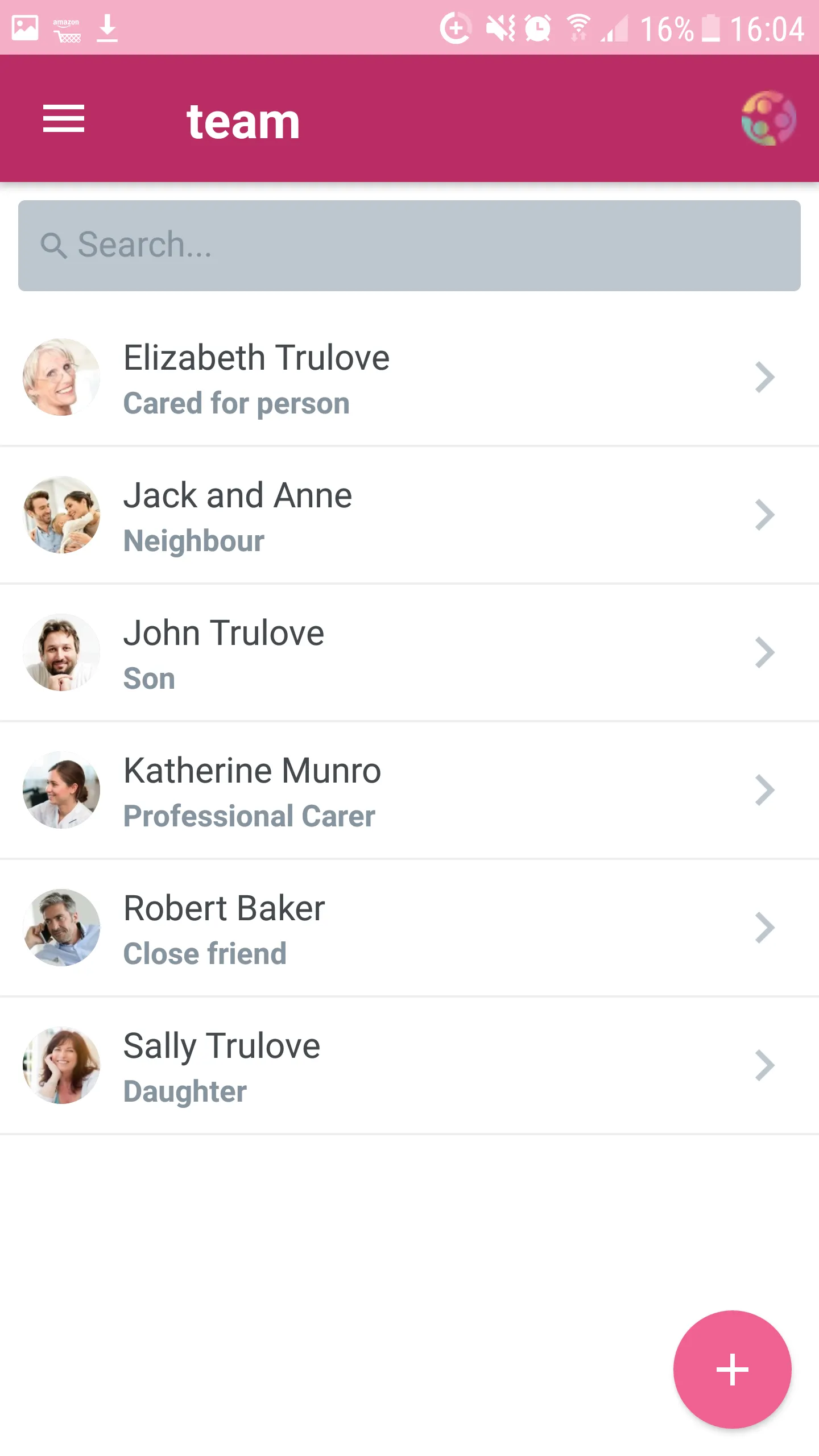
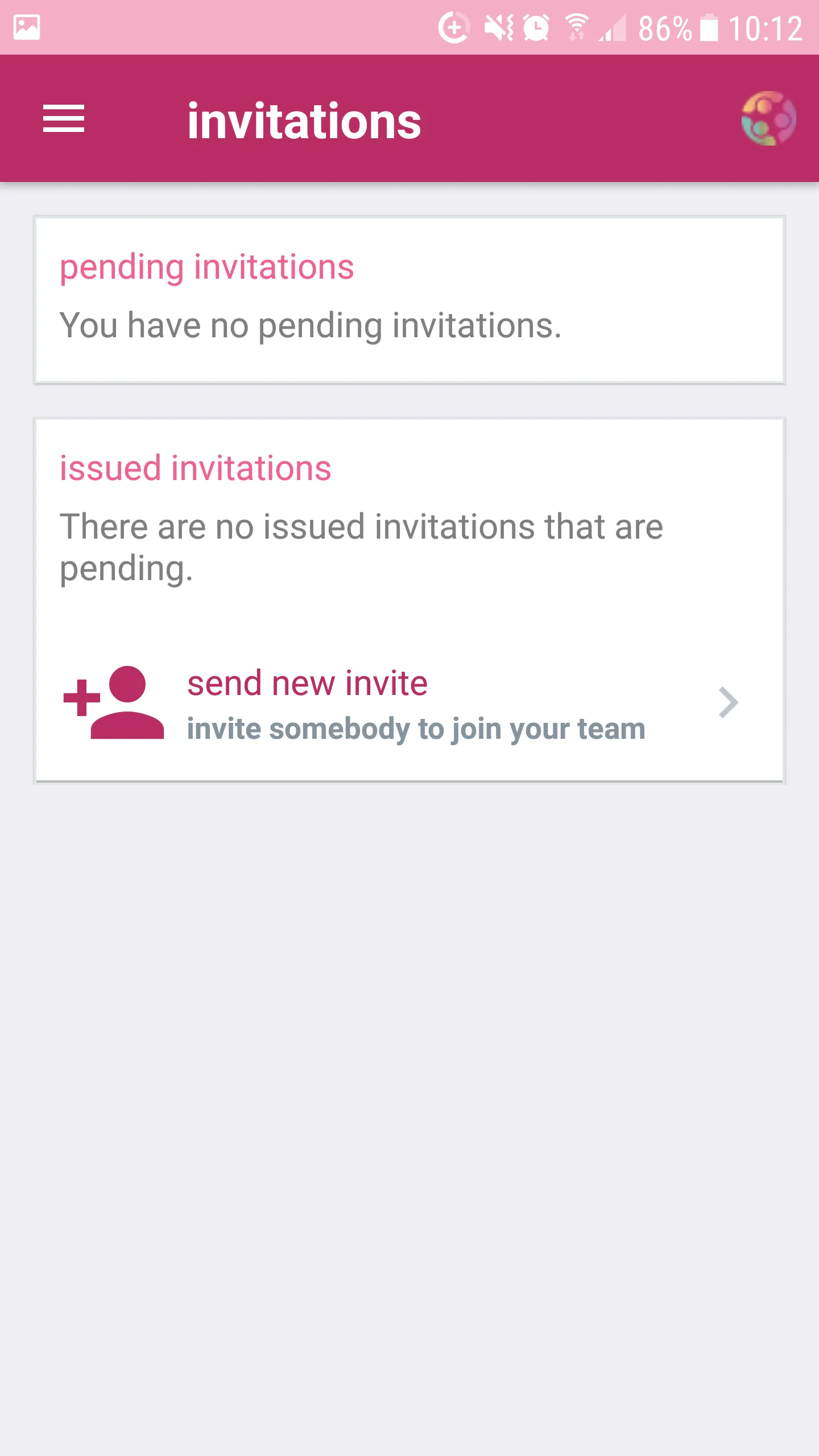
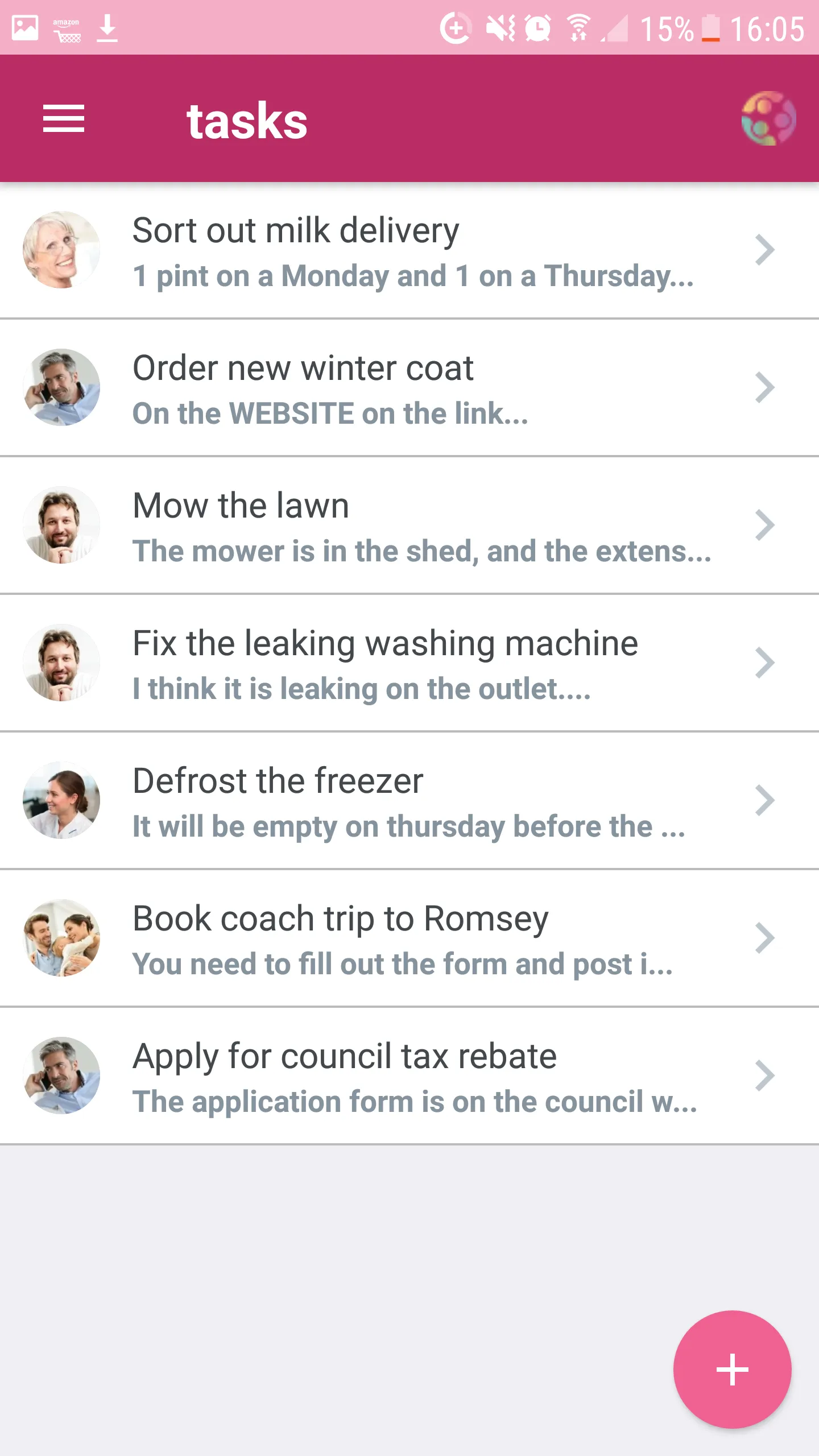
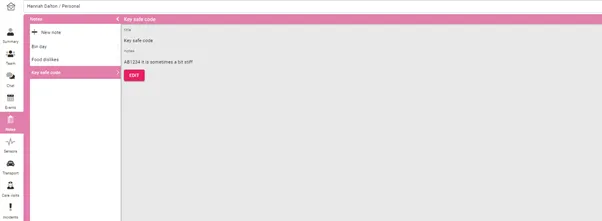
Team, tasks and notes. Team acts like an address book — CareTeam members can view other team members and securely share contact details. New team members can be invited to join; they receive an email and text message with simple instructions to download and sign up to the app. Tasks can be created and assigned so that everyone knows what needs to be done, with progress shared and tracked. Important information — such as key-safe codes and food preferences — can be securely shared with the relevant stakeholders.
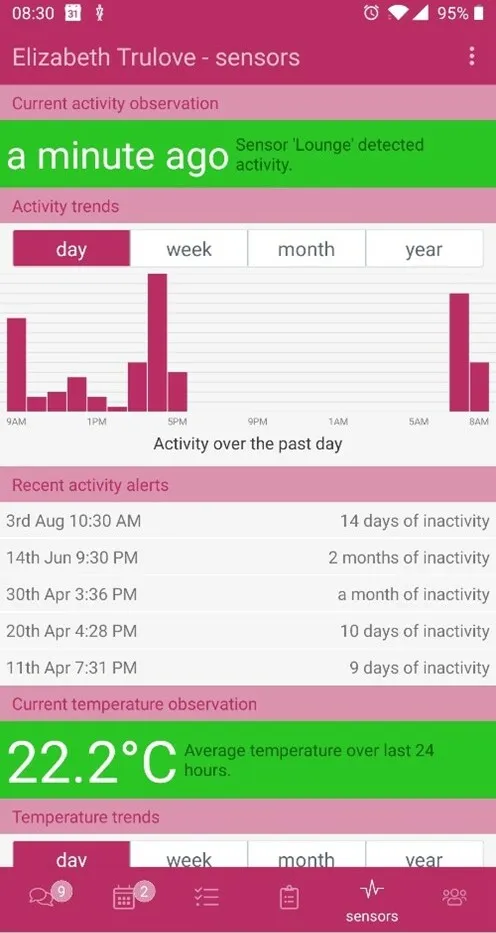
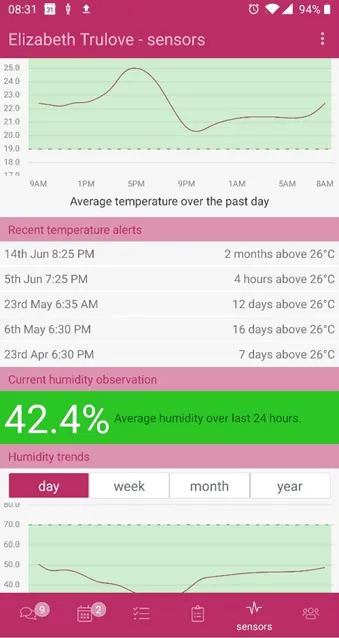
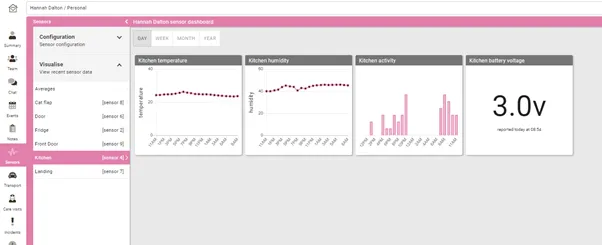
Sensors. Discrete sensors installed in service users’ homes allow motion, temperature and humidity to be recorded. Invited stakeholders can view data and receive alerts when certain conditions are met — for example when motion does not follow its normal pattern, or temperature or humidity fall outside acceptable thresholds. By allowing family carers to see that “everything is OK”, it provides peace of mind.
Transport. Lack of transport to important and social events can be one of the first things people need help with, and can have a significant impact on independence. Transport requests can be shared with informal carers and escalated to more formal providers such as community and voluntary organisations and professional transport providers.
The web platform
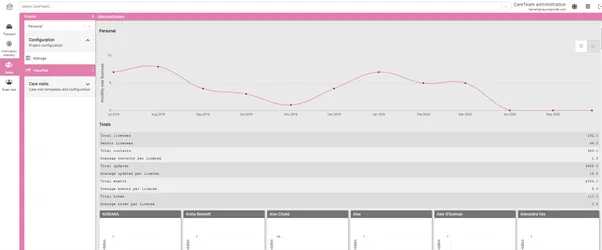
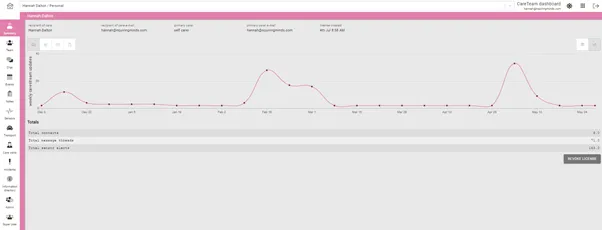
System overview. The administrator portal allows managers to administer accounts and see an overview of activity. The system overview displays the total number of users and activity on the system; administrators can add or amend accounts and change permission levels, and managers can monitor the detail of individual service users and make interventions where necessary. The Service User Overview provides a summary and visual display of a service user’s activity.
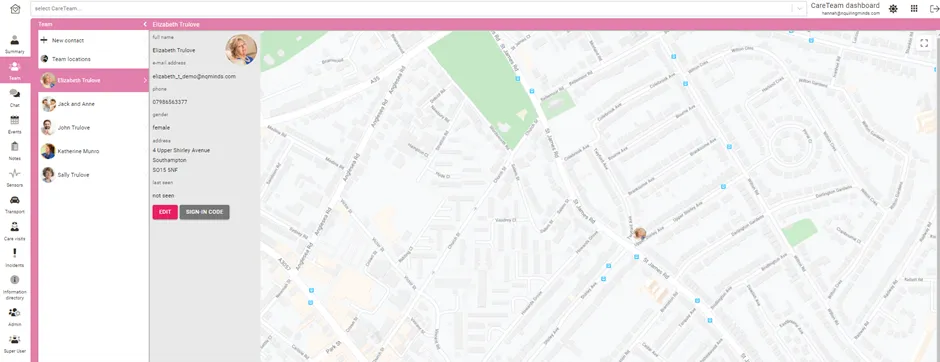
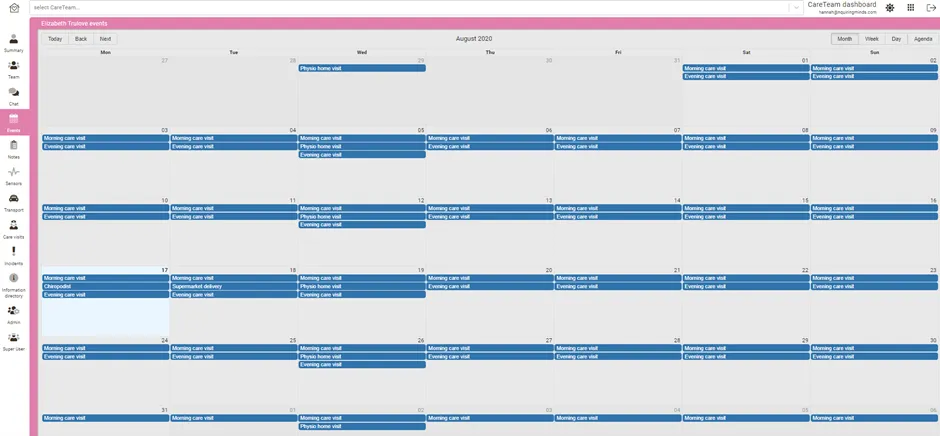
Service user platform. Allows service users and team members to access CareTeam information via the web, with similar functionality to the mobile app but without admin rights: view team details, invite new users, access sign-in codes and view team locations; see the calendar and scheduled care visits; view notes and task details.
Care visits. Templates can be set for both individual service users and whole-system care visits. Care visit summary information can be downloaded for use in finance and timesheet systems.
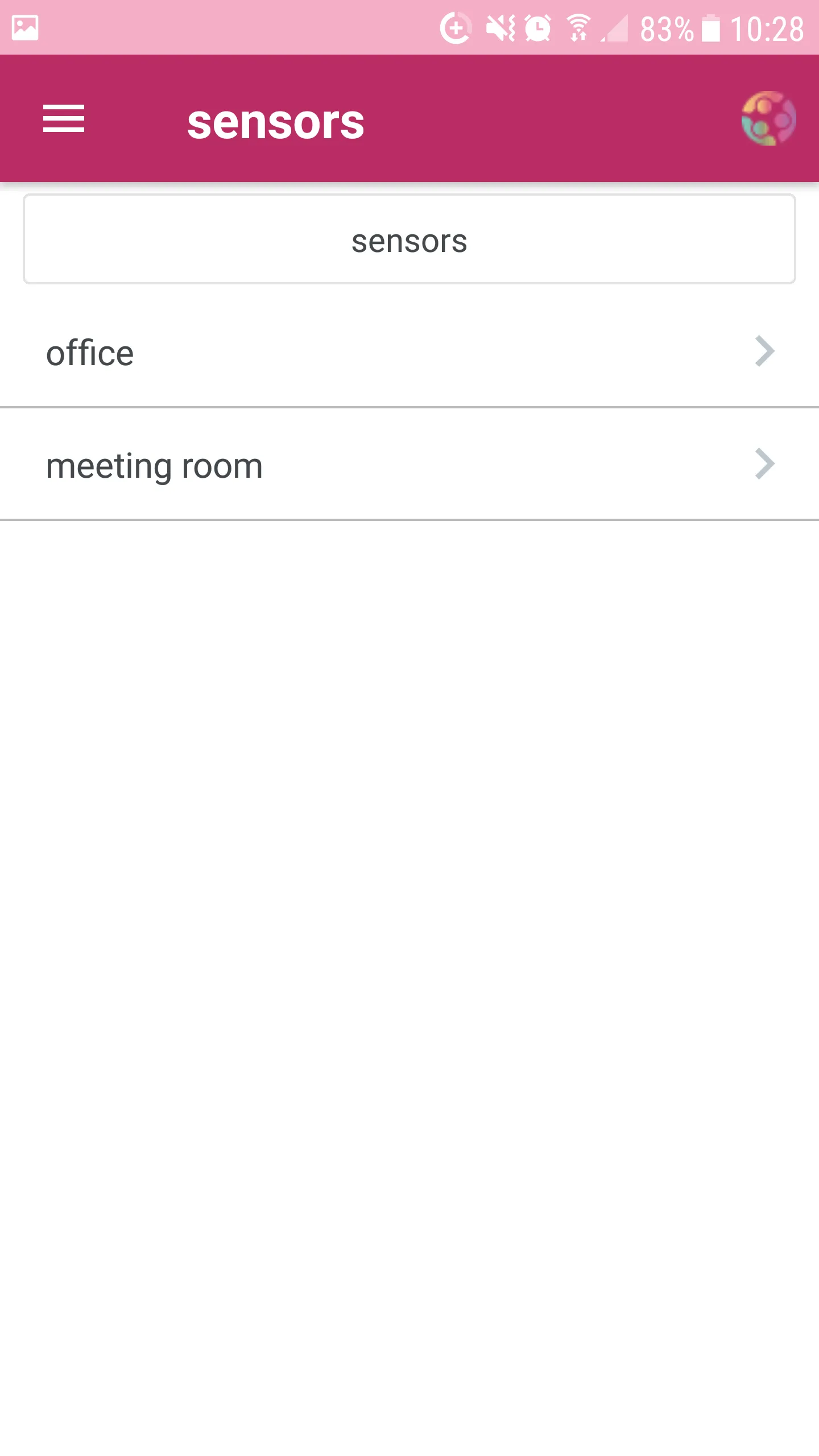
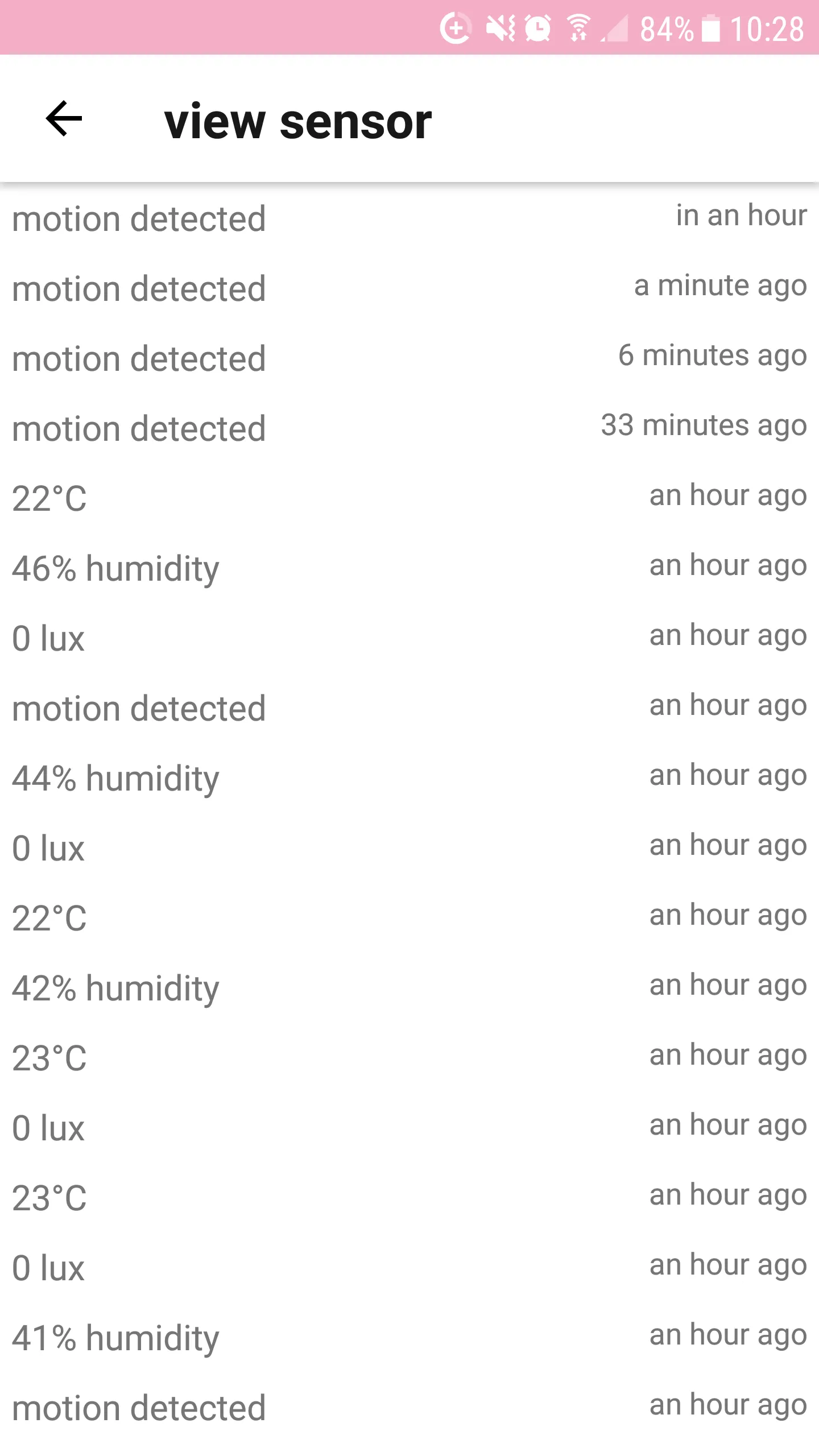
Sensors on the web. View sensor feeds in more detail, including individual sensor readings and historic data, and configure new sensors.

Features

Dynamic "find-a-carer" app and website.

Care commissioned in smaller units rather than long-term ring-fenced framework contracts.

Full integration of unpaid carers (family, friends, neighbours, charities) with professional services.

Citizen-centric care records shared privacy-centrically between citizens and organisations.

The largest care sector by economic measure — as a first-class, integrated part of care provision.
Benefits

New home-care model piloted in Southampton with the local authority and university (delivered).

More efficient commissioning and closer carer–citizen relationships (documented programme aims).

Evolved into the CareTeam product, continuing development and testing in new settings.

NQM featured by the Cabinet Office (June 2018, Industrial Strategy / Ageing Society) for tech helping elderly people stay in their own homes longer.
Volt features used

AI as first-order elements — fast

ML anomaly detection, pattern recognition and threat identification

configurable and dynamic policy

Human in and on the loop

wrap third-party / legacy systems that lack a mature API

true end-to-end encryption, peer-to-peer, no intermediate server

advanced NIST compliant security

fuse multi-source sensor and ISR data into a single coherent picture
Working with

News

NquiringMinds Featured by Cabinet Office for Innovation in Domiciliary Care
Cutting edge tech developed by @nqminds is helping elderly people stay in their own homes for longer 🏘️. See how the government is supporting an #AgeingSociety and have your say ➡️ https://t.co/3zcove13rY #IBF2018 #IndustrialStrategy pic.twitter.com/MlIh0Gacme — Cabinet Office (@GCSLondonSE) June 26, 2018.

First NQM CareTeam workshop in ICT Innovation in Elder Adult Domiciliary Care
nquiringminds led the first consultative workshop in the CareTeam project – an ICT innovation in the provision of elder adult domiciliary care. CareTeam is a collaboration between Southampton City Council, University of Southampton and nquiringminds. The workshop was facilitated by Wessex AHSN. CareTeam is focused on delivering ICT innovation to the challenges of providing care and.

CareTeam: Home Care Services Innovation Spearheaded in Southampton
CareTeam is an innovative model for the provision of home care (domiciliary) services initiated by nquiringminds (IOT innovator), the University of Southampton and Southampton City Council to rethink the problem of providing care in the home. We believe that technology has a crucial role to play in delivering more efficient care services. Sharing data between.
Related Sectors

Healthcare
The healthcare sector comprises a wide array of services, from hospitals and clinics to medical device manufacturing and pharmaceuticals. It is a vital sector that touches everyone's lives.

Public Sector
The public sector spans central and local government, councils and public services. Data-driven decision making helps these organisations plan services, allocate resources and improve outcomes for the communities they serve.