Offshore crane failure prevention for industry using AI structural health monitoring
Preventing catastrophic crane failures with continuous AI structural health monitoring.
The Challenge
Crane accidents are occurring with increasing frequency in ports and the construction industry worldwide. Failures of structural components lead to serious damage or total collapse, with financial losses of £125,000–£1.25m per accident plus injuries and fatalities — in 2008 Europe recorded 401 crane accidents, 209 related to structural failure, causing 217 deaths and 353 injuries. Inspection costs crane owners 0.8%–3.6% of capital cost annually, yet periodic human inspection still misses developing faults (TDX CraneScan).
The Solution
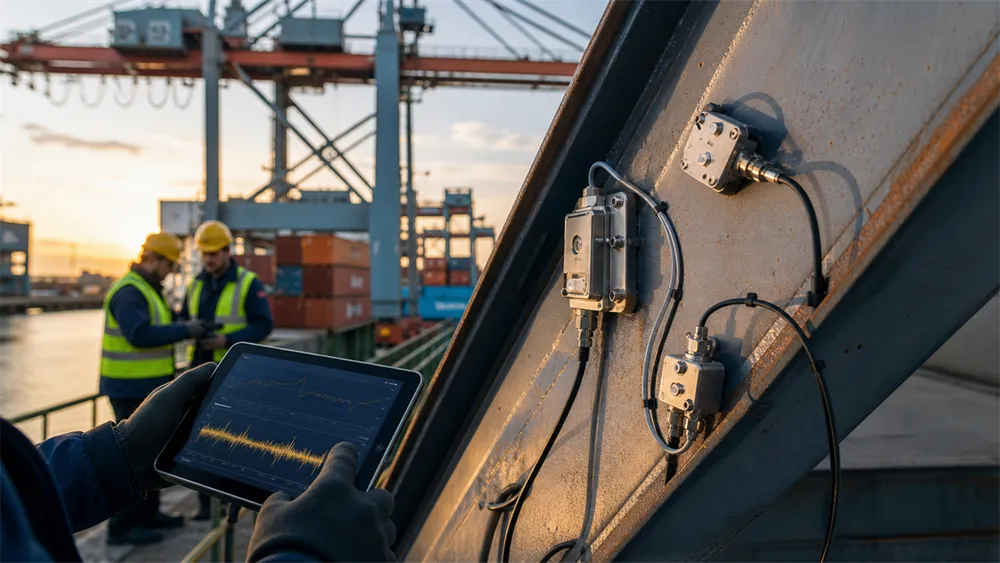
NQM’s TDX platform provided the secure sensor connectivity, data collection and analytics layer for an automated, continuous structural health monitoring (SHM) system based on advanced Acoustic Emission (AE) and Long Range Ultrasonics (LRU), developed with NDT and offshore-services consortium partners. Sensor data streams from the crane are fused and analysed to detect structural integrity faults automatically, without human intervention.
Outcomes
The project delivered a demonstrator of a commercial automated SHM system for large cranes (tower, gantry, mobile), targeting 90% detection efficiency and monitoring of crack sizes up to 10mm — catching integrity faults before they lead to crane failure.
In Detail

Ultrasonic monitoring of industrial cranes. CraneScan applies NquiringMinds’ multi-award-winning platform to one of Industry 4.0’s hardest problems: knowing the true structural health of a working crane, continuously, without taking it out of service. Acoustic emission and long-range ultrasonic sensors embedded on the crane stream data into secure cloud analytics that detect developing structural faults automatically — before they become catastrophic failures. The platform’s emphasis on security, connectivity and analytics makes it ideal for demanding industrial monitoring problems.
“In Industrial IoT technology, sensors are attached to physical assets, those sensors gather data, store it wirelessly, and use analytics and machine learning to take some kind of action.” — Robert Schmid, Deloitte Digital IoT chief technologist
CraneScan was delivered with an expert NDT and offshore consortium including The Welding Institute (TWI), NDT Consultants, rcm2 and Sparrows Offshore Services.
Features

No human inspection loop.

Advanced Acoustic Emission (AE) and Long Range Ultrasonics (LRU) sensing embedded on the crane.

90% detection efficiency target, crack sizes to 10mm.

Applicable to tower, gantry, mobile and offshore cranes.

Embedded NDT-grade inspection delivered as an always-on IoT/analytics service rather than periodic manual inspection.
Benefits

Structural failures detected before catastrophic and fatal accidents (accidents cost £125k–£1.25m each; 217 deaths in Europe's 2008 accident figures).

Reduced downtime, capital and insurance costs for crane owners and operators.

Reduced inspection costs (currently 0.8%–3.6% of capital cost per year).

Avoided environmental impact from container damage releasing hazardous substances.
Volt features used

AI as first-order elements — fast

ML anomaly detection, pattern recognition and threat identification

secure monitoring and telemetry

bearer agnostic

advanced NIST compliant security

fuse multi-source sensor and ISR data into a single coherent picture
Working with

News

Related Sectors

Industrial
The industrial sector covers manufacturing, construction, engineering and heavy industry. Sensing, monitoring and analytics are transforming how industrial assets are operated, maintained and kept safe.

Maritime
The maritime sector includes shipping, ports, naval operations and offshore industry. Connected sensing and secure data sharing are improving safety, efficiency and situational awareness at sea.