Net-zero building upgrade planning for landlords and property investors using AI scenario analysis
Turning net-zero risk into hard numbers on the property balance sheet.
The Challenge
UK domestic properties account for 35% of all energy used and 20% of carbon dioxide emissions, and the housing stock is old: reaching the Government’s 2050 Net Zero target means retrofitting energy-efficiency and low-carbon measures — insulation, boiler replacement, solar panels, EPC compliance — across millions of existing homes. For private and social landlords the financial implications are huge: an average retrofit costs around £30k per property and rising, and the return on property investment now depends heavily on shifting government policy, energy costs, compliance requirements and tenant expectations. Landlords and investors lack tools to turn these softly qualified environmental risks into measurable financial impacts.
The Solution
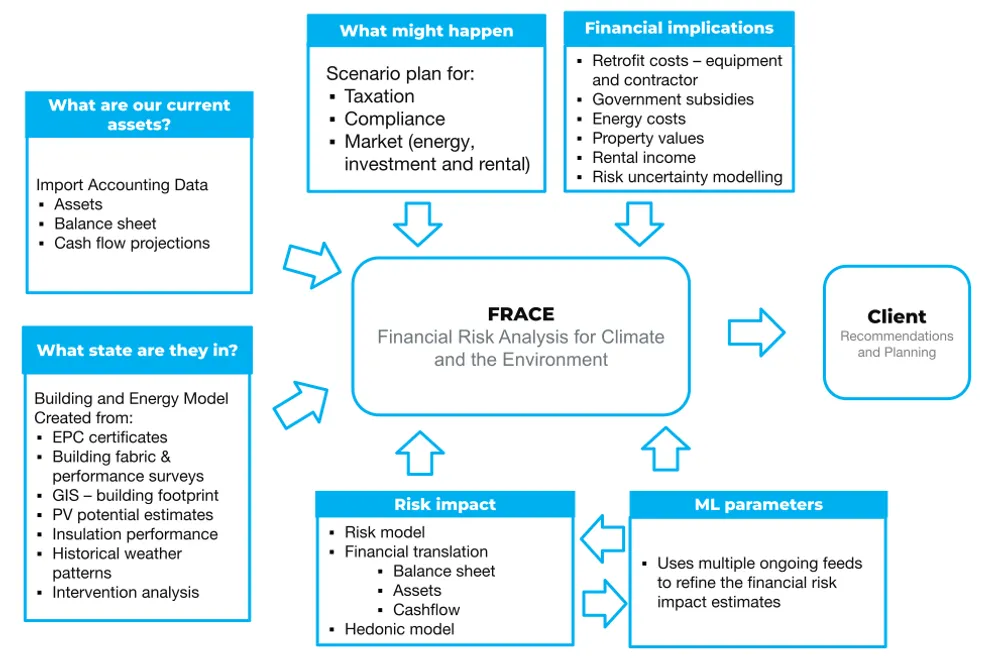
InteNZ (Intelligent NetZero Portfolio Analysis and Digital Assurance) embeds environmental and climate-risk analysis into financial decision-making for property owners. Built on NQM’s data-fusion and analytics platform, it combines current asset data from accounting systems (asset values, cash-flow projections) with building and energy-performance data (EPC certificates, surveys, mapping, energy usage, open data), scenario options (taxation, compliance, market pressures) and financial implications (retrofit costs and efficacies, subsidies, energy costs, property values, rental income). Advanced accounting techniques model these risks as discounts on the future projected value of assets — turning environmental risk into hard, measurable impacts on the balance sheet. For any given net-zero obligation, InteNZ determines which properties are affected, the options for compliance, and the financial implications of retrofit choices.
Outcomes
The work was delivered as a feasibility study developing and testing a scalable service proposition that reduces bills and carbon emissions from buildings, taking a data-driven approach to defining building upgrade pathways. Outputs include the feasibility study and the published whitepaper “NetZero Analysis for the Property Industry”; the technology draws on NQM’s AI-powered financial audit tooling, its real-estate scenario planner used by several local authorities, and an energy/building-stock modeller developed by the University of Southampton (shared with the related FRACE work).
In Detail
Intelligent NetZero Portfolio Analysis and Digital Assurance.

InteNZ embeds environmental and climate risk analysis into financial decision-making for property investors. It combines property asset details with finance accounting information in a model that allows the implications of different net-zero scenarios to be investigated. InteNZ uses advanced accounting techniques to model these risks as discounts on the future projected value of assets — turning softly qualified environmental risk into hard, measurable impacts on a company’s balance sheet and future projected revenues and costs.
Download the white paper: NetZero Analysis for the Property Industry
The net zero challenge

In the UK, domestic properties account for 35% of all the energy used and emit 20% of carbon dioxide emissions. The existing housing stock is old, so delivering the Government’s Net Zero ambition by 2050 means addressing domestic property emissions, with a focus on retrofitting energy-efficiency and low-carbon measures to existing properties. Such measures include improved insulation, replacement of gas boilers, solar panels and requirements to meet specific EPC standards, achieved through a series of taxation, incentive and legislation changes on top of the requirements already announced.
Increasing fuel costs, and people’s expectations for homes to be warm and comfortable — without damp, and with access to fresh air — mean tenants and the market pay ever more attention to the environmental performance of properties. Airborne pollution creates a tension between air flow and air quality, as well as heat loss and gain — difficult to solve in a cold and damp maritime climate.
For private and social landlords the potential financial implications of these shifts are huge. The average cost of a retrofit is £30k per property, and this is set to rise with tightening requirements and expectations. Investment in property, whether direct or indirect, is one of the cornerstones of the financial industry — and for such investments, climate and environmental risks play an ever-increasing role.
Core benefits
InteNZ models six categories of financial risk:
- Landlord costs — cost of energy and building-fabric retrofit to achieve environmental standards.
- Comparative costs — comparative cost to a developer of different build and energy strategies.
- Tenant costs — long-term cost to the tenant.
- Future capital — implications for future property value and rental income.
- Prioritisation — opportunity cost of prioritising one retrofit over another.
- Legislation — the changing legislative landscape, with scenario planning to anticipate the market.

Risk modelling
InteNZ is built on accounting techniques and scenario-planning tools that model the risks and discount the future projected value of assets, examining the costs and the implications of each decision. For any given net-zero obligation it determines which properties are affected, what the options for compliance are, and the financial implications for retrofit, property values, future costs and revenue. The method turns qualified environmental risks into hard, measurable impacts on a company’s balance sheet.
Scenario analysis

InteNZ is a scenario analysis tool that enables examination of the financial implications of different Net Zero options. It is a complex area, with risks ranging from fiscal and compliance measures to habitation trends. The return on investment for current and future property investment is therefore highly dependent on government policy, market performance, technology innovation, and the needs and wants of the people who live in the properties.
Data fusion

InteNZ combines the following data sources and elements:
- Current asset data imported from accounting information, including asset values and cash-flow projections.
- Building and energy-performance data such as EPC certificates, surveys, mapping data, energy usage and open data.
- Scenario options — changes to taxation, compliance requirements and market pressures.
- Financial implications — including retrofit costs and efficacies, subsidies, energy costs, property values and rental income.
- Risk model — examining the impact on balance sheet and cash flow.
Domain experts

The technology combines solutions that have been tried and tested in similar uses: an AI-powered financial audit tool for extraction and deep accounts analysis, a scenario planner for real estate used by several local authorities, and an energy and building-stock modeller developed by the University of Southampton that examines building refit options.
Get involved
We are looking to work with a handful of large-scale public-sector landlords and social housing bodies to help develop InteNZ into a working net-zero tool that scenario-plans and aids decisions for retrofitting and improving housing stock to meet the Net Zero Challenge. Partners have the opportunity to shape the tools to their requirements and to trial the system using their own portfolio data. Contact: info@nqminds.com.
Features

Which properties are affected by a given obligation and what compliance options exist.

Scenario analysis of taxation, legislation, market and technology options and their financial implications.

Cost, efficacy, subsidy, prioritisation and opportunity-cost comparison per property.

Environmental risks expressed as discounts on projected asset values, future revenues and costs.

Fuses financial accounting data with building/energy-performance data so net-zero risk appears as hard numbers in company accounts, not qualitative ESG commentary.
Benefits

Won and delivered a fully funded Phase 1 SBRI feasibility study (ref 10064438) under Innovate UK's Net Zero heat and power upgrades for demand reduction competition.

Data-driven building upgrade pathways that reduce bills and carbon emissions for landlords and tenants (competition objective; projection).

Published whitepaper "NetZero Analysis for the Property Industry" articulating the method for the property industry.


